Quantum Chromodynamics 2026, 13 - Coupling Expansions
At low energy QCD, there are few non-numerical studies, regardless of whether in lattice or in continuous space. Some understanding can be derived from tuning parameters to unphysical regimes. In lattice QCD action without fermionic effects, only one parameter β behaves proportionally to the inverse coupling squared. Very small β (i.e. strong coupling) or large (i.e. weak coupling) values can be explored through Taylor expansion of the plaquette over β (7.1.12 - 7.1.13). Similarly, for cases of large Wilson loops. From this calculation arise the relevant term diagrammatically. There are generally some unsaturated links from the plaquettes, which have to be filled up, yielding the nonvanishing contributions to the Wilson loops at lowest order in β. Perturbation theory defines the running coupling constant at lowest-order loop through an asymptotic scale parameter Λ, which depends on the regularization scheme. In lattice perturbation theory that scale is equal to Q = 1/a (7.1.14).
The string tension σ is about 1 GeV/fm, and can function as a scale for calculated quantities. The potential between quark and antiquark (σR, with R the distance between them) is expected to grow linearly with distance, by assuming a flux tube connecting them with color-electric field lines in tubelike configuration. No field lines leak out of the tube, so the field strengths are constant over its space (Eq. 7.161). Assume heavy quarks to apply a nonrelativistic quark potential, which is necessary for observing lattice QCD (p. 479). The quark gluon interaction term jμAμ = ρA4 with color charge density ρ (Eq. 7.163) that assumes the charge at a spatial parameter x (= 0) and the antiquark is on a lattice site with distance R defines in part the action per time SE = -i∫d4xρ(x)A4(x) = -i(A4(0) - A4(R)) (Eq. 7.165). The result is time-independent (Eq. 7.166) and can be approximated by a closed-loop integration on the lattice given a large time interval w.r.t. |R|. Applying the Wilson-loop method, one can average over all gluonic configurations, which yields a potential V(R) = -ln[ω(R, T)]/T (Eq. 7.171) (7.1.16).
At finite temperatures, the strong interactions derive from the partition function at finite value for β, and under time-evolution (p.482). The Wilson action can be rewritten under these conditions and by averaging over space-time plaquettes (p. 484),
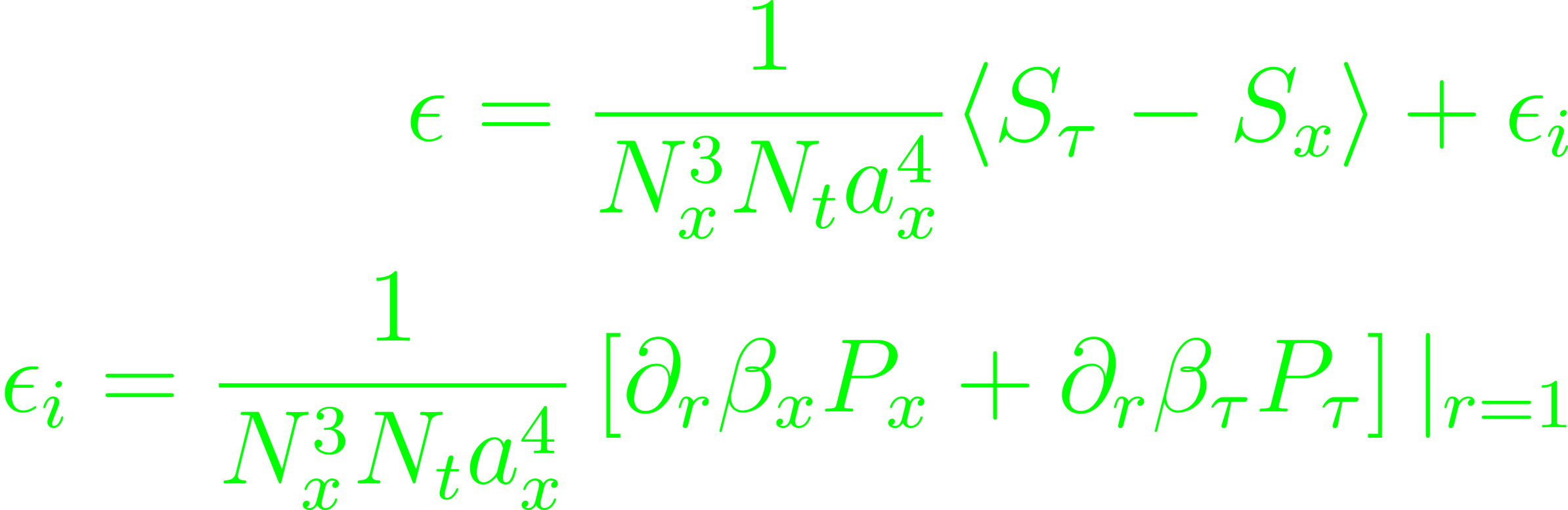
(Eq. 7.186 - 7.187) with ϵi is the contribution to the energy arising from coupling on scale change (7.1.16).