Loops, Knots, Gauge Theories and Quantum Gravity 2026, 40 - Solutions of Constraints
The extended representation is a powerful computational framework for calculations in the loop representation, from which it derives its value. The expression for the coefficient A2(γ) in terms of the multitangent fields allows for generalization of the knot invariant to extended loops, and into the Hamiltonian constraint in extended representation.
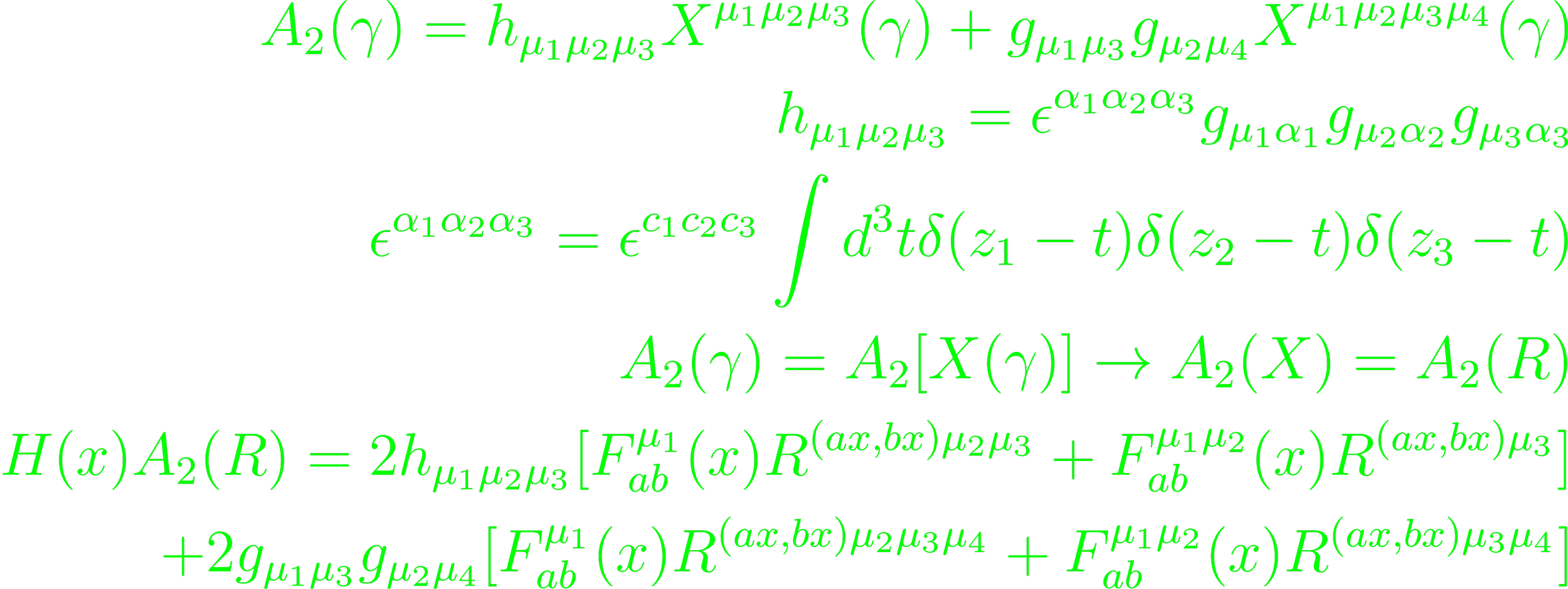
(Eqs. 11.66-70). By explicit computation, H(x)A2(R) = 0 (Eq. 11.82) (p. 291).
The multitensors are generically distributional. Y = δT X satisfies the homogeneous differential constraint and can be chosen to be smooth. In that case, the divergence of X is concentrated in the ϕ functions. The set of elements of the extended space X ∈ {X}s is well defined iff there is a prescription function ϕ, so that Y is a smooth function. The wavefunctions on that domain are smooth in the extended variables, and that property is invariant under diffeomorphism transformations (p. 292). The expressions for the knot invariants are divergent, so they don't arise as a restriction of a smooth expression in terms of extended loops (11.6.1). The constraints in the extended representation are so far ill defined, and require regularization by point-splitting. The process is straight-forward (p. 294). There is a factor ordering to ensure consistency between known results in the connection representation and the loop representation. Regularization introduces an extra term to the Hamiltonian, which is considered anomalous. It shows up in the brackets under the integrals as (gawbu - gawbv)gμ1gμ2R(auμ1bvμ2)c (Eq. 11.97). The limit of after removing the regulators have to take into account the divergences of the group elements and g-tensors. Both types contribute to the same order (p. 296). The contraction of g with R in non-contiguous indices is a regular expression, so it's well defined without singularities. The finite expression for the Hamiltonian then needs renormalizing of the point-split version by a factor of ε (Eq. 11.103)