Loops, Knots, Gauge Theories and Quantum Gravity 2026, 39 - Extended Loop Representation
Wavefunctions are related to those in the connection representation by the extended transform Ψ(X) = ∈ DA Ψ[A]WX[A] with the extended Wilson loop WX (Eq. 11.3). The multitensors X are under a differential constraint (Eq. 11.5) and span a space of multitensors Do. If the algebraic constraint is ignored, the resulting representation is simpler, as it avoids non-linear constraints. The degree of redundancy in the description is higher. The structure of the gauge group includes the Mandelstam identities. The multitensors have the form
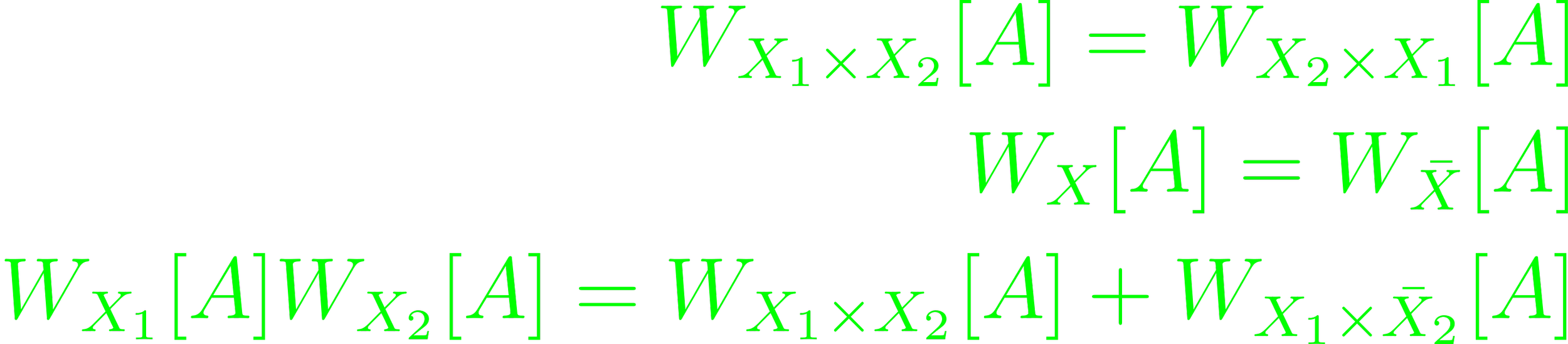
(Eqs. 11.6-8). The first identity corresponds to the usual cyclic property of traces, the second to the inversion of loops. The wavefunctions in extended representation is that they're linear functions of the extended coordinates, because the extended Wilson loop is as well. The linearity is remarkable in this representations, because all the wavefunctions know in the loop representation for quantum gravity are linear, when written in terms of the multitangent fields (p. 279). The functional derivatives produce elements of the extended groups of loops and the second functional derivative is the group product of the resulting elements. The observable of the theory can commute with the linearity constraint, and the action of the quantum observable on a wavefunction reduces to a shift in its argument. The non-linearity is traded for an increased number of arguments in the extended representation. The physical operators are also linear operators in this representation (Eqs. 11.22-24) (11.2). The constraints of quantum gravity in terms of the extended representation. Starting with the diffeomorphism constraint, applied to the generalized Wilson functional. The functional derivative of any product of A-tensors can be written using the δ-matrix and generators of the SU(2) algebra τ (Eq. 11.30), which, when traced and with the curvature tensor gives the diffeomorphism constraint on the generalized Wilson functional (Eq. 11.31, 32, 35). An element of the group R(bx) has components defined by [R(bx)]μ = R(bx)μ = R(bx μ)c (Eq. 11.37) where the Greek indices are assumed to be representatives of a set. The expression must be extended to an exteneded holonomy (Eq. 11.45), which then recovers the Hamiltonian constraint (11.3).