Loops, Knots, Gauge Theories and Quantum Gravity 2026, 38 - Topological Field Theories
Chern-Simons is a gauge theory in 2 + 1 dims where the action has the Chern-Simons form of connection

where k is the coupling constant (Eq. 10.33). It doesn't require the introduction of a metric or background structure, is invariant under diffeomorphisms and small gauge transformations, but not under large gauge transformations. The integral provides the gauge invariance. The expectation value of a Wilson loop over SCS is a knot invariant under diffeomorphisms and assume the measure DA chosen to be invariant. It satisfies skein relations of the Kauffman bracket polynomial (p. 255) (to first order in the area of an added loop (p. 256)). Chern-Simons is associated with knot invariants for intersections (10.4.1.). The original intention in connecting knot theory and topological field theories was to obtain explicit expressions for knot invariants. Chern-Simons is perturbatively renormalizable, so it can compute an explicit expression for the Wilson loop expectation as written in Feynman diagrams (which is equal to the Kauffman bracket) (Eq. 10.52). The Kauffman bracket relates to the Jones polynomial through a framing-dependent prefactor that condenses all the framing dependence of the Kauffman bracket (p. 262). The factor ordering in which triads appear to the left, there is a solution to all the constraints of QG with cosmological constant given by the exponential of the Chern-Simons form (Eqs. 10.65-67). The emerging expression is the same as for ⟨W(γ)⟩. The Ashtekar formulation of QG is complex, whereas in Chern-Simons it's real, so the analogy of the expressions is only formal (p. 265). It does still give a number of consistent result, which makes it valuable (10.5.1). Calculation is order by order in the cosmological constant, polynomials in Λ, which is meant to vanish in orders of Λ.
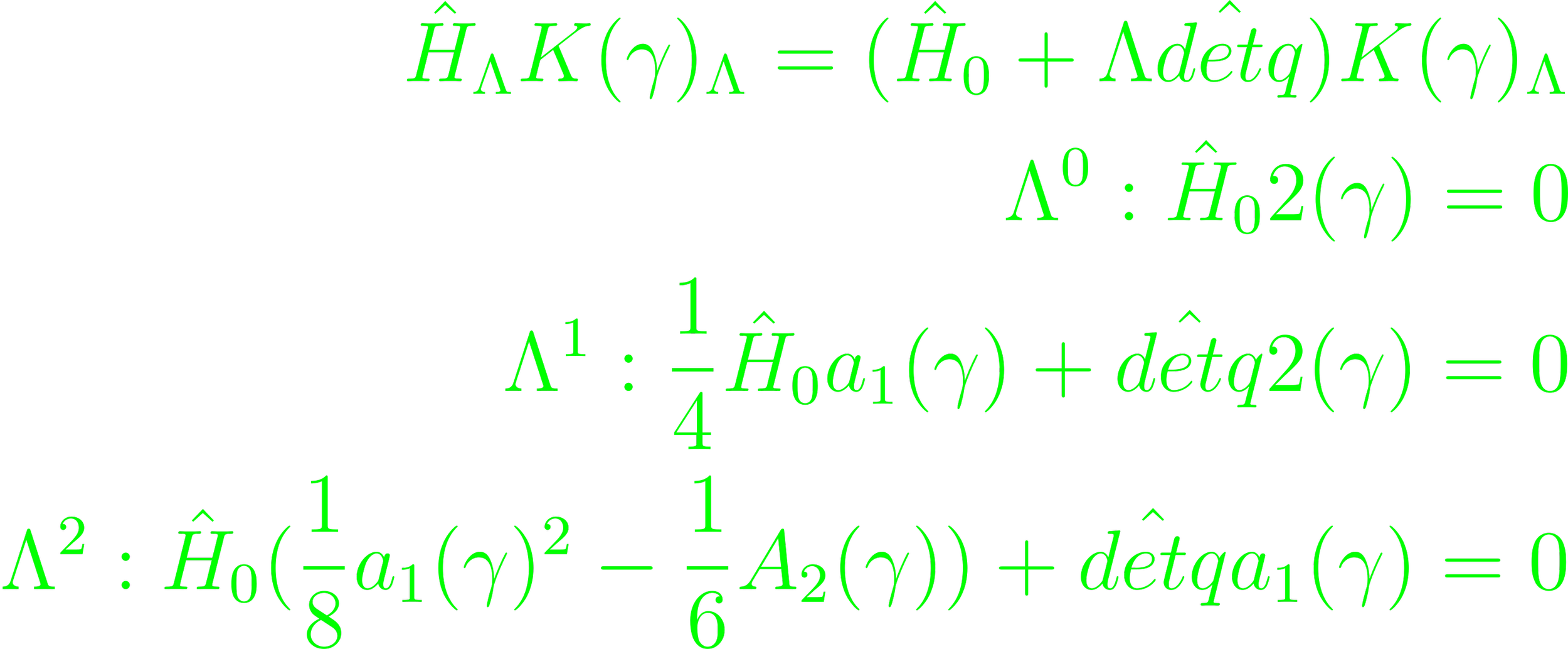
(Eqs. 10.68-71). By calculation, the contributions to the orders in Λ will vanish. In the contribution to order Λ2, H0A2(γ) vanishes independently, identifying the second coefficient of the expansion of the Jones polynomial being annihilated by the Wheeler-DeWitt eq. for vacuum general relativity with zero cosmological constant (10.5.2).
The Kauffman bracket can be written as a loop transform of the exponential of the Chern-Simons form (Eq. 10.83), which can be computed explicitly. The prefactor relating the Kauffman and Jones polynomials arises like the Abelian limit of the bracket. The Kauffman bracket solves the Wheeler-DeWitt equation with a cosmological constant. There is no systematic way of considering Abelian limits in terms of loop representation (p. 273). The total action of the vacuum Hamiltonian constraint on the exponential of the self-linking number is equal to the action of the determinant of the metric. This gives a non-trivial solution of all constraints of QG in the loop representation. The Hamiltonian constraint with cosmological constant is solved through

(Eq. 10.86). The solutions correspond to the vanishing limit of the cosmological constant as a constraint on the Hamiltonian.