Loops, Knots, Gauge Theories and Quantum Gravity 2026, 37 - Knot Theory and Polynomials
The linking number is an invariant of two closed curves measuring the number of times one of them winds around the other. Maxwell uses it in the electromagnetic theory. A thin solenoid with shape of each loop in the integral measures the magnetic flux produced by each solenoid across the other. It's not trivial to distinguish knots through the values of any knot invariant, but it's able to detect up to a certain degree of knotting. The fundamental problem of knot theory is the classification of knots and links (p. 239). A knot can be projected a number of ways, smooth deformations of knots in 3D space translate themselves in a series of motions by the Reidemeister moves. There are three types of Reidemeister moves (unloop, sliding past and pulling over). Knot projections can be mapped into each other, if it can be done through a finite number of these. In the knot Knots connected in that way are considered ambient isotopic, which builds the relevant equivalence relation for Loop Quantum Gravity. It corresponds to diffeomorphism invariance (p. 240). Two knots are regular isotopic if they can be connected through Reidemeister moves of "sliding past" and "pulling over". Those are unaffected primarily by the knots made of ribbons, whereas unlooping will not result itself in a smooth deformation, due to the curl (p. 241). Knots relevant to quantum gravity have to be functions of the group of loops rather than curves, should satisfy Mandelstam identities and should be well a well defined function of intersecting loops (10.2).
A set of n vertical strings with their endpoints aligned in horizontal lines, so that they cross each other an arbitrary number of times, forms a braid that can be arranged so that each horizontal level only contains one crossing at the i-th strand (note gi). This braid has two possible orientations (gi and gi-1). The twists form the group structure of the Artin braid group. For n strings, Bn has n - 1 generators with gigj = gjgi; |i - j| > 1 and gigi + 1gi = gi + 1gigi + 1 (Eqs. 10.2 - 3). The strings involved can be interpreted as spacetime trajectories of particles in 2+1 dimensions as they orbit around each other. A knot appears when gloing together the ends of a braid in an order preserving manner. The advantage of this description is that several properties of link diagrams can be coded into the braid. Link invariants are functionals of the elements of the braid group, which are also invariant to Markov moves. The closure is the expression in terms of the group (10.3.1).
A knot/link polynomial is an assignment of a finite set of numbers to a knot/link invariant under ambient or regular isotopies. A knot γ has a polynomial P(γ)q in an arbitrary variable q where all coefficients pi(γ) of the polynomial are knot invariant. Each knot of the polynomial is of finite order, but the order is characterizes the particular knot. They assign an unlimited number of invariants to knots according to their complexity. The expectation constitutes a systematic procedure for classifying knots. On the flipside, only a few polynomials are known explicitly. A known polynomial is defined by the skein relations C(U)q = 1; C(L+)q - C(L-)q = qC(L0)q (Eqs. 10.4-5) where U is the unknot and L±0 refers to the crossing-types (over/under/none) (p. 246). Unless a set of relations includes a skein relation, it's difficult to determine the value of a polynomial (10.3.2).
The braid group doesn't have a complete classification of irreducible representations yet, and finding representations is non-trivial. A 2D linear space Vi is associated with the i-th string, s.t. the total linear space is given by a tensor product with a basis generated by a matrix GI = q1/4(I ⊗ ... ⊗ R ⊗ ... ⊗ I) (Eq. 10.16) where I is the 2 × 2 identity and
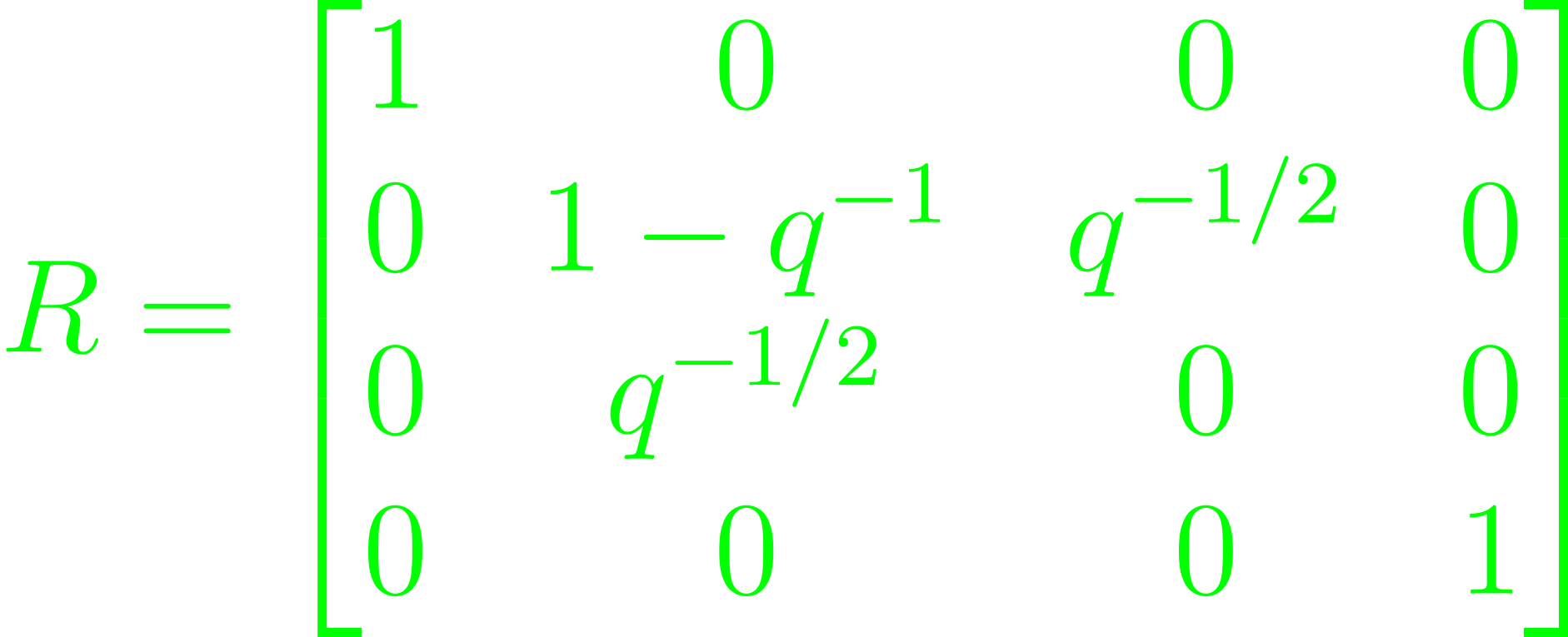
(Eq. 10.17), (10.3.3). The case of gravity needs to consider knots with intersections, because the Mandelstam identities introduce them with non-degenerate metrics. No fundamental difficulties in adding intersections to the constructions of the braid group and the Jones polynomial we introduced. The braid group can be extended by an additional element for the crossing of two strands, resulting in a full algebra. The additional element includes double intersections, written ai with aigi = giai; gi-1ai+1gi = gi+1aig-1i+1; [gi, aj] = 0; [ai, aj] (Eq. 10.26-28). ai has no inverse (p. 252).