Loops, Knots, Gauge Theories and Quantum Gravity 2026, 21 - Maxwell Theory
Maxwell theory can be fully derived from a subgroup of the full group of loops, since the theory is Abelian. The elements of the group of loops behaves as κ = γ ○ η ○ γ-1 ○ η-1 (Eq. 4.1), where γ and η might consist of any arbitrary number of loops (meaning that they are commutators). The set of all such loops and their products form a subgroup of the group of loops, written as Lcomm. This construction forms a normal subgroup, with a quotient group, defining a quotient group LAbel = L/Lcomm with equivalent class γ ~ η ⇔ γ ○ η-1 = κ ∈ Lcomm (Eq. 4.3), which identifies the commutators in the group of loops with the identity. Given a representation of the Abelian subgroup, the loops are related by matrices H(γ) and through an Abelian multiplication that transfers into the parenthesis. This identifies the operator HA(γ) = exp(i∮γ dyaAa(y)); HA(γ) = WA(γ) (Eqs. 4.6 - 7). The resulting representation only depends on the information of the loop contained in the first order loop coordinate (p. 90). Because the function W is invariant to infinitesemial deformations of the loop argument, the loop derivatives are no longer path dependent, but just point dependent, and they commute in the Abelian case (4.1).
The classical canonical Maxwell theory is written
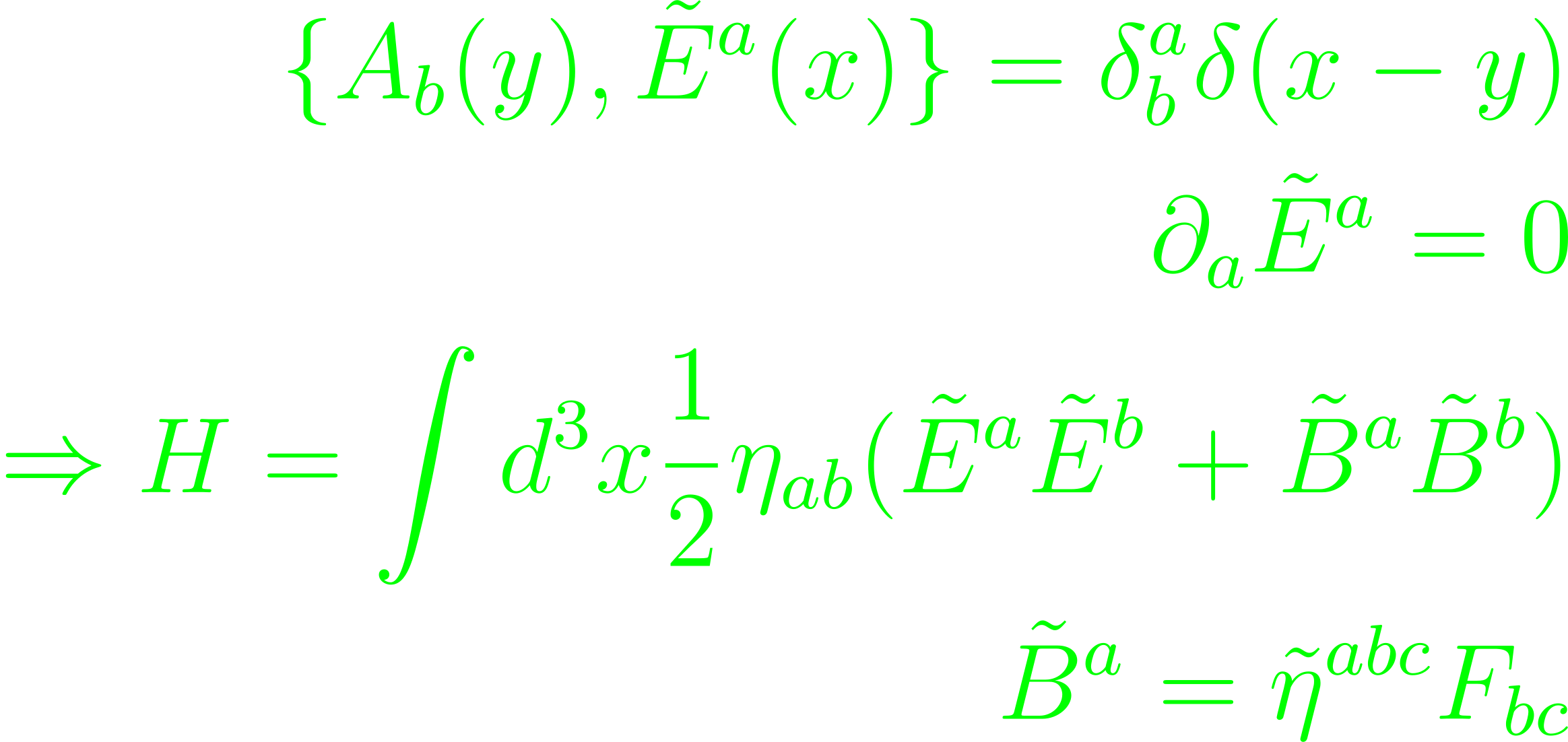
(Eqs. 4.13 - 15), assuming a flat, 3D Euclidean metric. The commutator of the electric field and the connection with the Hamiltonian give the time-evolution. The canonical theory can be adapted for transverse fields entirely, which translates the tensors in the Dirac brackets and contracts the deltas into the transverse Dirac delta. This can be simplified to use the momentum space variables for A and E, which define generalized coordinates, which behave as {qA(k), pB(k')} = δBAδ3(k + k') (Eq. 4.22). With this, the Hamiltonian gains the usual creation/destruction operators (p. 92). Fock representation can be arrived at through the quantum representation of the algebra in a space of functions of infinite pairs of integer variables, representing the state of each harmonic oscillator for any mode and an associated polarization. This defines the Hermitian operator N(k, C) as usual without summation over C. This reproduces the regular dynamics of the creation/annihilation operators of quantum dynamics. Similarly, these inherit the normal-ordering operations. This, in turn defines the minimal energy state as the one, for which aC(kj)Φ0 = 0 ∀ k, C (Eq. 4.41). Without restrictions on the eigenvalues of the operators, the resulting basis is overcomplete.