Loops, Knots, Gauge Theories and Quantum Gravity 2026, 20 - Loop Representation
Wilson loops form an overcomplete basis of solutions of the Gauss law, so they can be used to construct a quantum representation, purely in terms of these loops.
In one approach to this, a transform is defined between the connection and loop representations, which allows for conversion of any gauge invariant operator or wavefunction into an object in loop representation. Alternatively, an algebra of quantities parametrized by loops can be defined, and applied as the first step of a Dirac quantization, which yields the loop representation (p. 73).
Through translation of objects into momentum representation, a set of operators Tn with Fourier transform F(Tn), which satisfy a non-canonical algebra. The Fourier transform introduces the quantum representation. The non-canonical classical Poisson algebra is reproduced by the quantum commutator algebra. The parameters for the transformation as arbitrary. The action of these operators is analog to the action on a space of kets, though the ordering in ket space representation is opposite to that of the wavefunction space (p. 74). The introduction of the loop transform to single-particle solutions can be thought of as performing an inner product in the connection representation between wavefunctions and basis elements, given that the wavefunction is subject to the quantum-mechanical norm, which resolves to 1 = ∫ DA|A><A|. The basis usually chosen actually utilizes products of Wilson loops, so that the resulting functions are gauge invariant (p. 75).
Alternatively, starting with a free particle on classical phase space, and with the same non-canonical algebra, any classical quantity can be expressed through this same algebra. The quantization could then also be performed with the same means as one would have performed it before the transformation. Otherwise, a quantum realization of the algebra will lead to the same goal, but requires checking that the classical algebra is reproduced a quantum level (3.5.0.).
Assume initially, the existence of a loop transform. This implies the existence of cylindrical measures, which reduce the infinite-dimensional integral to a finite set of integrals over the gauge group. Via consistency between projections, the theory of infinite-dimensional space of a Klein-Gordon field is spanned. A scalar field ϕ in flat space-time satisfying Klein-Gordon has a classical configuration space which coincides with the set of all smooth field configurations on a spatial manifold. Its quantum states are functions on the space of classical configurations Ψ(ϕ), which multiplies as ∫DμϕΨ'(ϕ)Φ(ϕ), with some suitable measure μ that is to be determined for each ϕ. Functionals for ϕ emerge from convolution with the classical configurations. The integral should act upon a cylindrical measure, so the intermediary g(ϕ) is defined cylindrically for g(ϕ) = G(Fei(ϕ), ...), given a set of real variables G. Its integral needs to be well defined and consistent for any set of subspaces Vn. The Cauchy-completeness of the set determines a quantum theory through functions on an enlargement of the classical configuration space. The cylindricality of g(A) is given through the space of connections mod its gauge transformations, which holds for exactly connections that go through the value of the associated holonomies (Eq. 3.98).
An alternative introduces quantities on the classical phase space of a gauge theory first
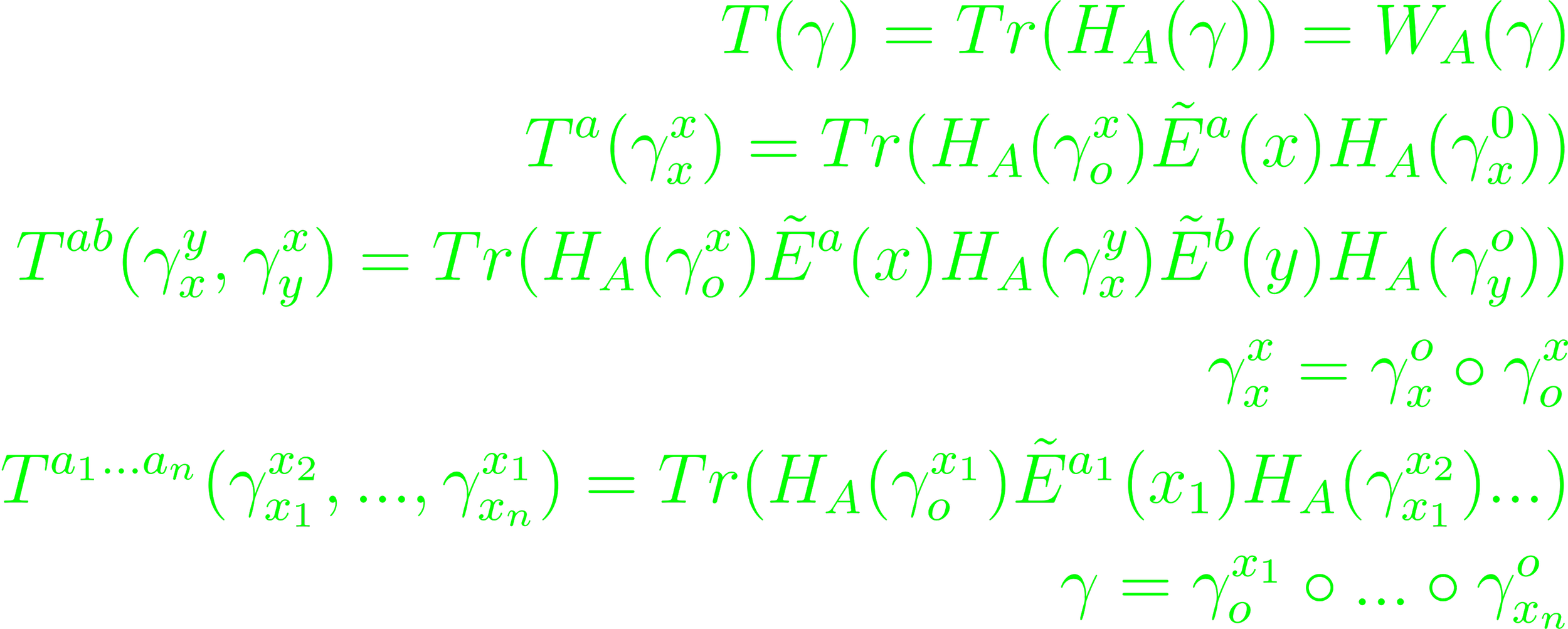
(Eqs. 3.99 - 102). These T(γ) are Wilson loops, and the other quantities break up the holonomy at points xi with electric fields inserted and continuing the holonomy until back at the basepoint. They are gauge invariant. Tk behave as multivector densities. The T0s and T1s close an algebra (p. 81). Their commutator defines the behavior of intersecting loops. Schematically, {Tn, Tm} ~ Tn+m-1 (Eq. 3.112). Wave functions in the loop representation inherit properties of Wilson loops through their definition Ψ = ∫d __A__WA*(γ1)...W__A*(γn)Ψ[A] (Eq. 3.115). They are symmetric under interchange of arguments (Eq. 3.116), and they form conjugacy classes of the group of loops (Eq. 3.117). They inherit Mandelstam identities as the Wilson loops do (p. 85). As a consequence, any functional of any number of loops in terms of a functional of a single loop.