Gauge Theories in Particle Physics 2026, 42 - Isospin in flavour SU(2) and SU(3)
The only ground state of a series in doublets are neutron/proton states. Baryonic levels have four charge states with T = 3/2. In the meson sector, πs appear as the lowest states of a sequence of mesonic triplets. No baryon states are known with T > 3/2 nor any meson states with T > 1. The observed states then are composites of basic entites with different charges and (almost) degenerate masses, while forces between them are charge independent. This coincides with the mechanics of quarks. The quark wavefunction can be similarly written as a doublet
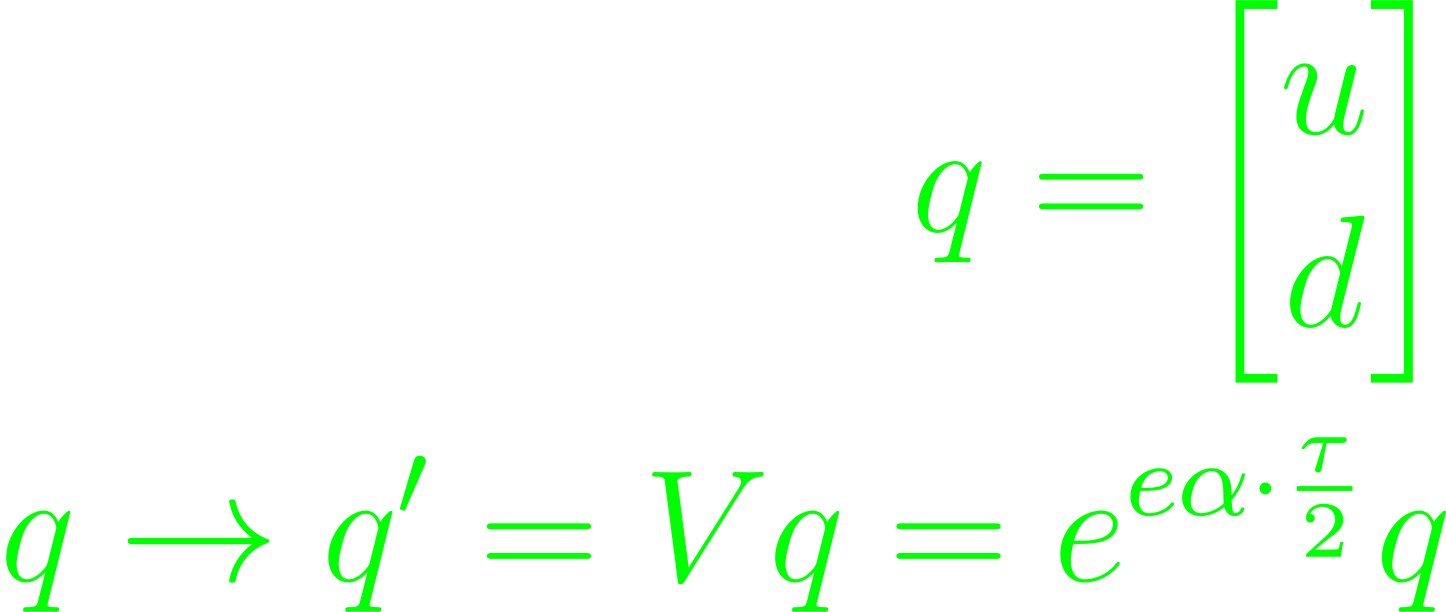
(Eqs. 12.50-51). The limitation for baryonic states then arises from their composition of three T = 1/2 constituents. At quark level, the concept of antiparticles is first modeled through the isospin. They transform differently under SU(2)ftransformations, but their are at least "dual" through unitary equivalence (p.16). The quantities vi = q†τiq; i = 1, 2, 3 under SU(2)f transforms into specific linear combinations of themselves and form the basis for a representation (p. 17). With linear combinations of these base vectors, the charged pion quarks can be expressed using
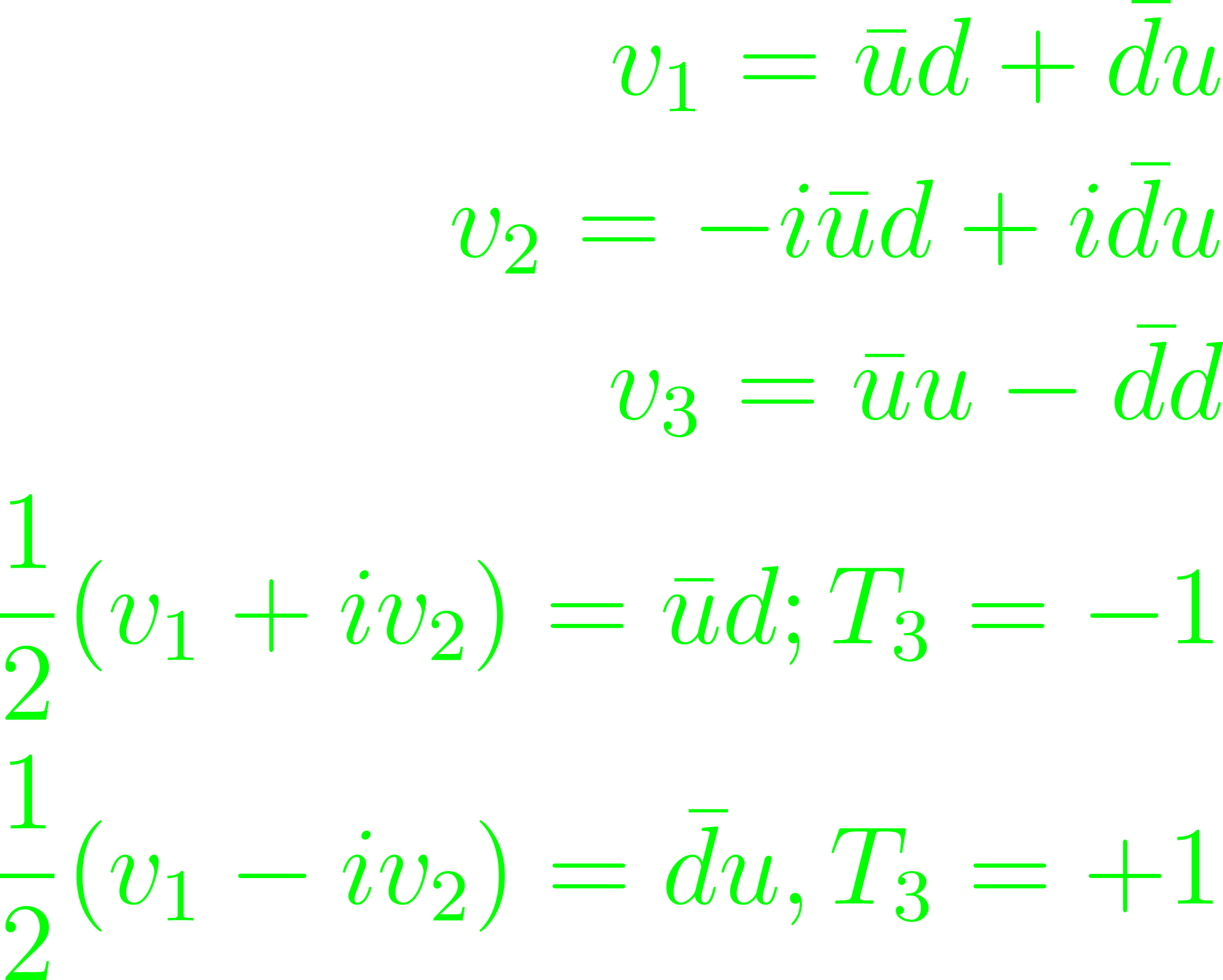
(Eqs. 12.66 - 68) (12.2). Larger hadronic multiplets exist under SU(3)f, which functions analogously, with the addition of the strange-quark s, so the 3-component row vector is q = (u, d, s). The general form of an SU(3) matrix W and the traceless 3 × 3 Hermitian matrix χ = η λ/2 where η is the vector of parameters of the infinitesimal transformation and λ are the Gell-Mann matrices (Eq. 12.72), whose eigenvalues are constants of motion, but due to commutation relations, not all of them have simultaneous eigenstates. Infinitesimal Winfl = 13 + iχ (Eq. 12.71). λ3, 8 are diagonal in the chosen representation, so for SU(3), there are two additively conserved quantum numbers, which are the third component of hadronic isospin and a quantity related to strangeness. The hypercharge Y = B + S; S(u) = S(d) = 0, S(s) = -1 has the eigenvalues imply the hypercharge operator Y(3) 3-1/2λ8. From this follows the Gell-Mann-Nishijima relation for quark charges in units of |e| (p. 20). The diagonal Gell-Mann matrices are analogous to τ3. The fundamental representation for SU(3) and its complex conjugate are not equivalent, unlike in SU(2), but are distinguished through the extra quantum number Y (p. 21). In SU(3), the 8-component parameter vector ω is analogous to η (Eqs. 12.81 - 82) (12.3).