Gauge Theories in Particle Physics 2026, 41 - Global Non-Abelian Symmetries
We can never have enough gauge theory, so here goes. Gauge Theories in Particle Physics is the fifth volume of a series, but I'm guessing that it'll be a fine read for someone with a particle physics background. I'm expecting for this to include a lot of familiar stuff, but Considering that I'm craving practice, this is probably not the a bad next read.
It It starts off with the SU(2) group on the wavefunction ψ' = eiαψ (Eq. 12.1), which for specific particles decompose into a sum of degenerate partial wave functions with coefficients (Eqs. 12.2-7), which ultimately leads to the 2-isospin formulation of a wave function (Eq. 12.8-9). Given this formulation, a 2-component spin vector can be used along with a complex 2 × 2 matrix V consisting of the coefficients. The general form of the matrix V under the various relevant restrictions has the same form as the transformation matrix of real spin wavefunctions under rotations of the real space axes (p. 7). It depends on four complex parameters, restricted down to three free parameters, which is the normalization of ψ(1/2)

(Eqs. 12.11-12) which makes V unitary. Additionally, |det V|2 = 1 (Eq. 12.13). Matrices like these form the SU(2) group. SU(2) is a Lie group, so their physical consequences are mapped through infinitesimal transformations iξ, which are matrices V, differing only slightly from the no-change situation corresponding to V = 12. ξ in SU(2) is a 2 × 2 traceless Hermitian matrix (3 free parameters), which can be written in a tensor form with the help of the 2 × 2 Pauli matrices τi (Eqs. 12.20-25). The emerging definition for V can be inserted directly into the spinor equation (Eq. 12.27). Via linear algebra considerations, the electromagnetic charge operator is defined then as
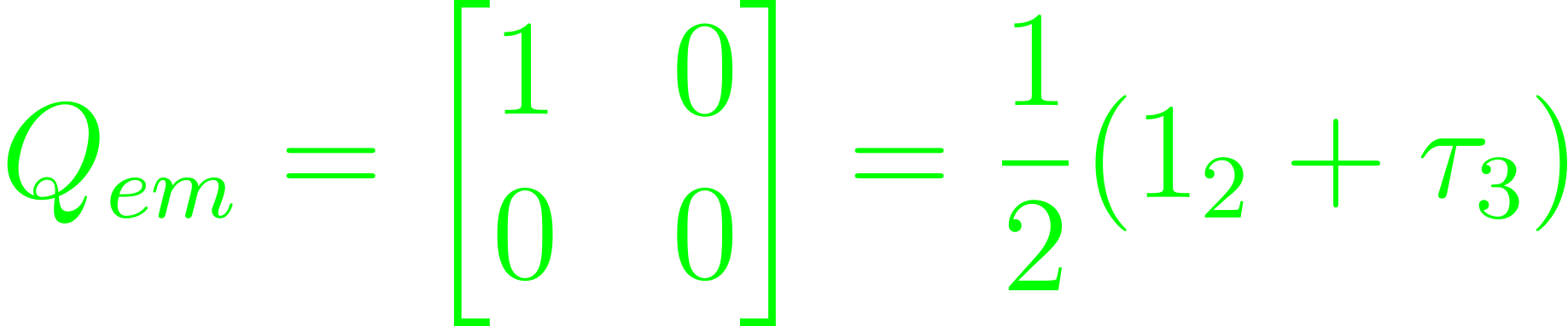
(Eq. 12.44), and it commutes only with the 3-Pauli matrix (12.1.1). The real isospin as applied to several-nuclei systems is a sum of τi/2 over the τ-matrices of each nucleon. The Hamiltonian for the strong interaction is invariant under the transformation for all nuclei independently, and so [H, T] = 0 (Eqs. 12.45-46). Directly, [Ti, Tj] = iεijkTk (Eq. 12.47) (12.2.2).