Fundamentals of Plasma Physics 2025, 49 - Dust Ion Acoustic Waves
The derivation for the dust ion acoustic waves stems from the linearized electron and ion equations (Eqs 17.50-51). Strong Landau damping occurs when the wave phase velocity is of the order of the ion thermal velocity (17.6). By eliminating the electric field contributions of the linearized electron and ion equations, the dust acoustic wave has a phase velocity of

(Eq. 17.55). It approaches singularity for α approaching unity. The mutual repulsive force between two negatively charged dust grains scales will be large for highly charged dust grains, and can exceed their kinetic energy, leading to a crystallized state (17.7, par 1). Large Zd corresponds to large ψd, which saturates with increasing Te/Ti (17.7, par 2). The interactions are modeled by

(Eq. 17.56-56). All ions approaching the dust grains are accelerated, so no zero-velocity ions exist near the dust grains. An ion starting with infinitesimal inward velocity at infinity where ψ = 0 has near zero energy. The ion's dynamics are described by
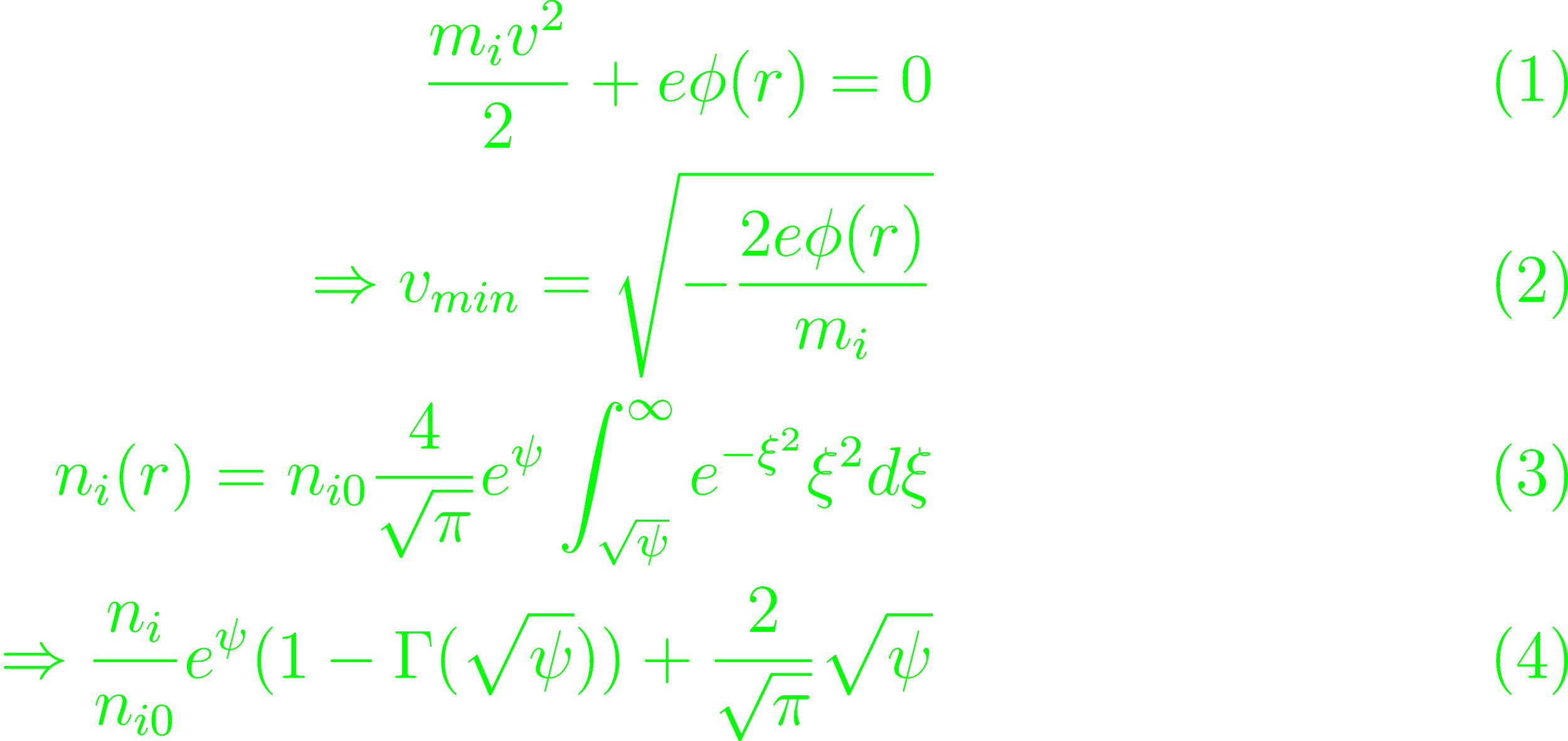
(Eq. 17.63-68). For ψ ≪ 1,

(Eq. 17.70). For ψ ≫ 1, a Boltzmann dependence emerges.

(Eq. 17.72). The Poisson equation balances the vacuum contribution against the ion, electrons, and dust contributions (Eq. 17.74). These terms can be used to define regions, depending on the values of the vacuum contributions. It either has the vacuum term vanish, equal to ψ + α, or (1 + αZ)ψ, which emerge from approximation that ψ >> 1, ni/ne0 = 1 + ψ, and the "general" case (Eq. 17.75-77, p.499).