Convex Optimization 2026, 32 - Distance Between Sets
The distance between sets C, D is defined as dist(C, D) = inf{||x - y|| : x ∈ C, y ∈ D}. If dist(C, D) > 0, they don't intersect, and if it's equal 0, they do. Also, dist(C, D) = dist(0, D - C). If C = {x : fi(x) ≤ 0, i, ..., m}; D = {x : gi(x) ≤ 0, i = 1, ..., p}, then dist(C, D) is determined by minimizing ||x - y|| where fi(x) ≤ 0 and gi(y) ≤ 0 (Eq. 8.3). This extends analogously to polyhedra (Eq. 8.4) (8.2.1). The dual of finding the distance between two convex sets is expressible through separation of hyperplanes between those sets. It minimizes ||ω|| with fi(x), gi(y) ≤ 0 and x - y = ω (Eq. 8.5). The resulting dual function is

which diverges for all ||z||* > 1 toward -∞. This, too, extends directly to polyhedra (8.2.2). Using indicator functions, the distance between two convex sets minimizes ||x - y|| with IC(x) ≤ 0; ID(y) ≤ 0. The dual of this maximizes -SC(-z) - SD(z) with ||z||* ≤ 1 (8.2.3).
Lengths, distances and angles can be expressed through a Gram matrix G = ATA; A = [ai... ], i.e. Gij = aiTaj. Its diagonal entries can be considered to be known and fixed, and comprise the lengths li. The distances between ai and aj are dij = ||ai - aj||2 = (li2 + lj2 - 2Gij)1/2. Define the correlation coefficient
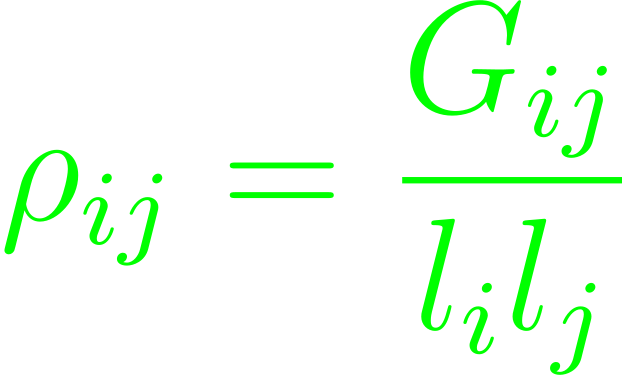
which defines the angles between as θij = cos-1ρij. Due to its construction, G is symmetric and positive semidefinite (p. 406). Constraints can be imposed on the angle through its associated lengths liljcos α ≥ Gij ≥ liljcos β for α ≥ θij ≥ β. A similar constraint can be imposed on the distances (p. 407).