Quantum Chromodynamics 2026, 15 - Quark-Gluon Plasma
The phase-transition at critical temperature should be hypothesized to exist for all SU(N) gauge groups. The resulting quark-gluon plasma is assumed to have been relevant in the early universe. The QCD vacuum is a highly nontrivial state. The density of hadron states was described to grow exponentially, which implies a limiting temperature. Assuming E/m0 ≫ 1, the total energy density can be approximated to a term only depending on E and m0.
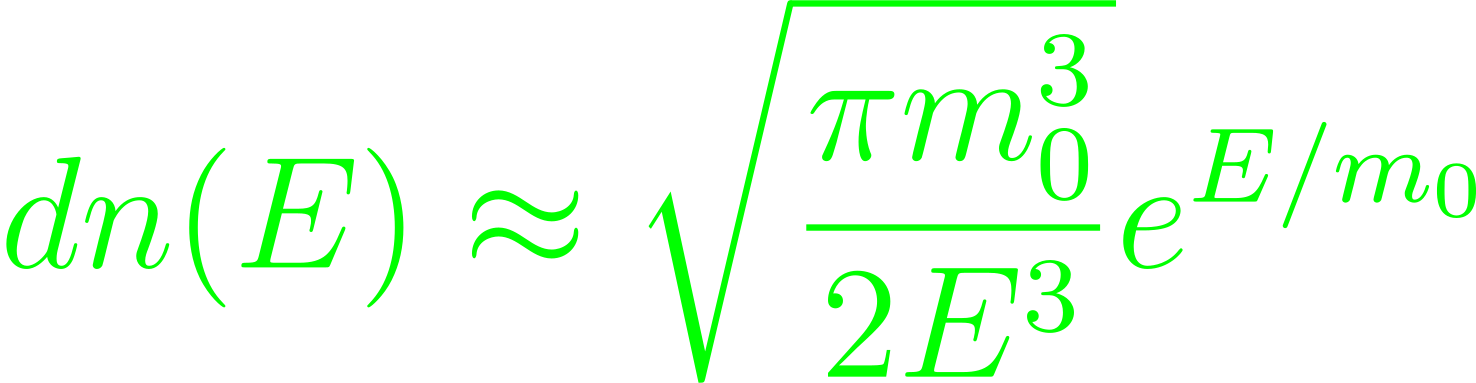
(Eqs. 8.35 - 38). It diverges for kT > kT0 = m0 which is at about 200 MeV. For quarks and gluons, the phase transition can be linked to a reduction of the effective running coupling constant with increasing temperature. Finite temperature implies that the state would have to be calculated with a thermal distribution of particles. The resulting effective coupling constant becomes small enough to suggest the insignificance of nonperturbative effects. The transition is further modified by the finite baryon density in a heavy ion collision, characterized by the chemical potential. It defines the the estimate for the phase-transition line in terms of the bag constant (Eq. 8.43).
When many particles take part in an interaction, a hydrodynamic description applies except at highest collision energies, so large energy depositions function primarily through nuclear shock waves. The projectiles are deflected for suitable parameters. Based on this, the phase transition at 200GeV/A is achievable, though it's unclear whether signals can survive the hadronization that follows. Such signals have yet to be observed. The coupling to the thermal bath at high temperatures reduce the effective coupling constant. By perturbation theory, an effective propagator emerges in which the longitudinal and transverse color-dielectric functions can be separated, and the longitudinal gluon field can be specifically screened out (8.2).