Loops, Knots, Gauge Theories and Quantum Gravity 2026, 35 - Kalb-Ramond Fields and Surfaces
The set S of closed 2D oriented surfaces in ℝ3 with a surface s and s' its reverse-oriented surface defines an associative, commutative product s1 ○ s2 = s1∪s2 without inverse element (Eq. 9.28). All trees are elements of S s.t. the integral of all scalar functions on them vanishes. The composition of two elements of s resulting in a tree is an equivalence relation, whose quotient set is an Abelian group Σ with elements σ. In U(1), the kinematic structure of the Kalb-Ramond field use the field tensor and antisymmetric tensor potentials Δabc(z) = ∂aδbc(πoz) + ∂bδca(πoz) + ∂cδab(πoz) and δab (9.4.1). Abelian Kalb-Ramond fields Aab = -Aba have Fabc = ∂[aAbc] and Maxwell action

(Eq. 9.36). Their action is invariant under gauge transformations (Eq. 9.37); the Hamiltonian formulation follows through the Gauss law constraint associated with the gauge symmetry (9.4.2). The metric in terms of the new variables is easily regularized and renormalized. Its general result. Regularization involves products of Dirac delta functions and renormalization replaces the product of such two functions by a single one, which automatically introduces forms of density. This should include a density weight. Regularization without renormalization avoids this problem (p. 222). The operator of this regularization is finite and independent of the background structure, used to define the regulator, so no renormalization is needed. The quantity associated with a surface S with normal vector na has infinitesemial area dA with
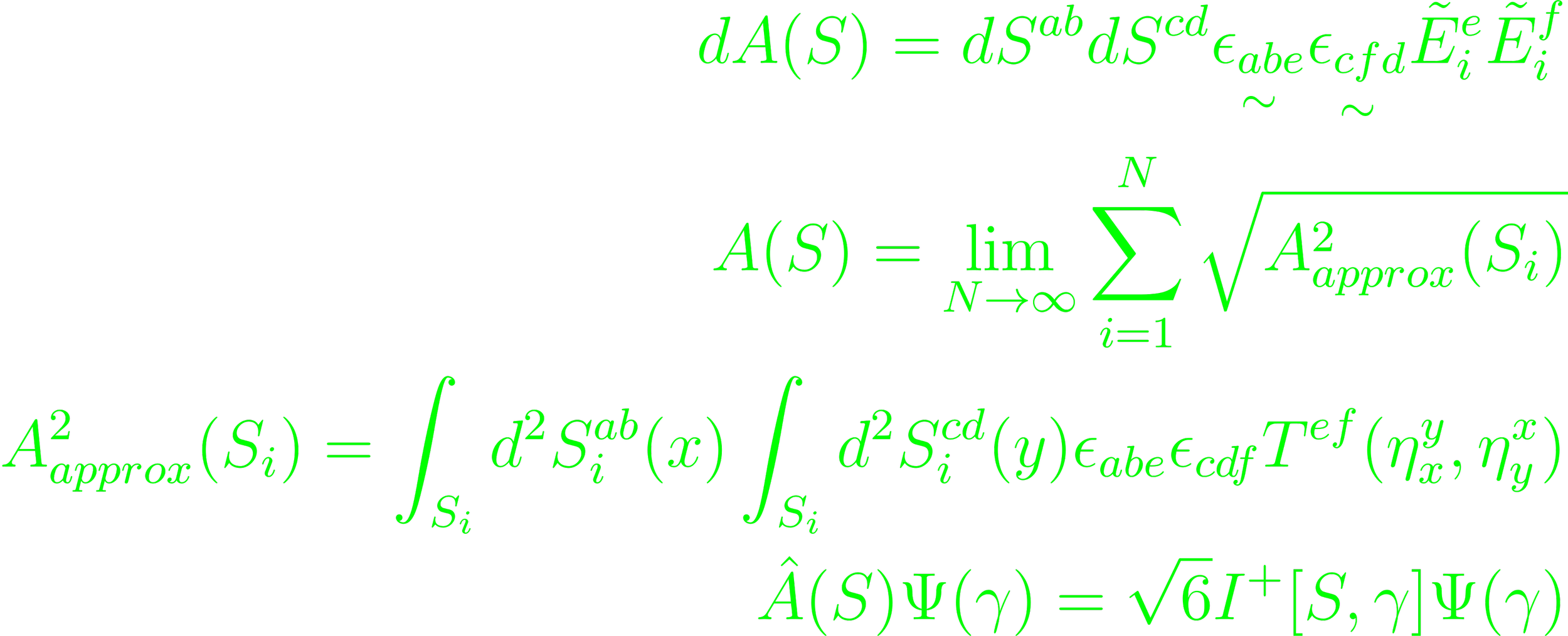
(Eq. 9.51-53, 9.56). The intersections of the A-operator are not ignorable, because support on intersecting loops renders it out of the eigenstates of A2. Both operators' square roots benefit on support on loops without intersections.
In quantum theory, physical information is encoded through correspondence theory, expressed through a semi-classical limit. The relevant states with 3-geometry to which one wants to associate a state distributes randomly a number N of points, this results in a set of curves which can be considered a representative element of a multiloop. If those are without intersections, and are linked, the action of the Q-operator is smooth on the scales determined. The eigenvalue of the operator to approximate its classical value on the 3-geometry associated with the state <Δ| to order l/L. The result is a natural cutoff scale in quantum gravity to recover classical physics.