Loops, Knots, Gauge Theories and Quantum Gravity 2026, 29 - Hamiltonian Lattice Formulation
A field configuration is determined by an assignment of SU(2) to each lattice link, depending primarily on the lattice orientation, and expressed through either a matrix U(l) or the "reversed" U(l)-1. With A(l) the element of the algebra, then write U(l) = exp(iag A(l)) with lattice spacing a and coupling constant g. Introduce a variable canonically conjugate to U that acts as the electric field at zero lattice spacing limit and generally transforms as the electric field does under gauge transformation in continuum. This is E(l) with Poisson brackets
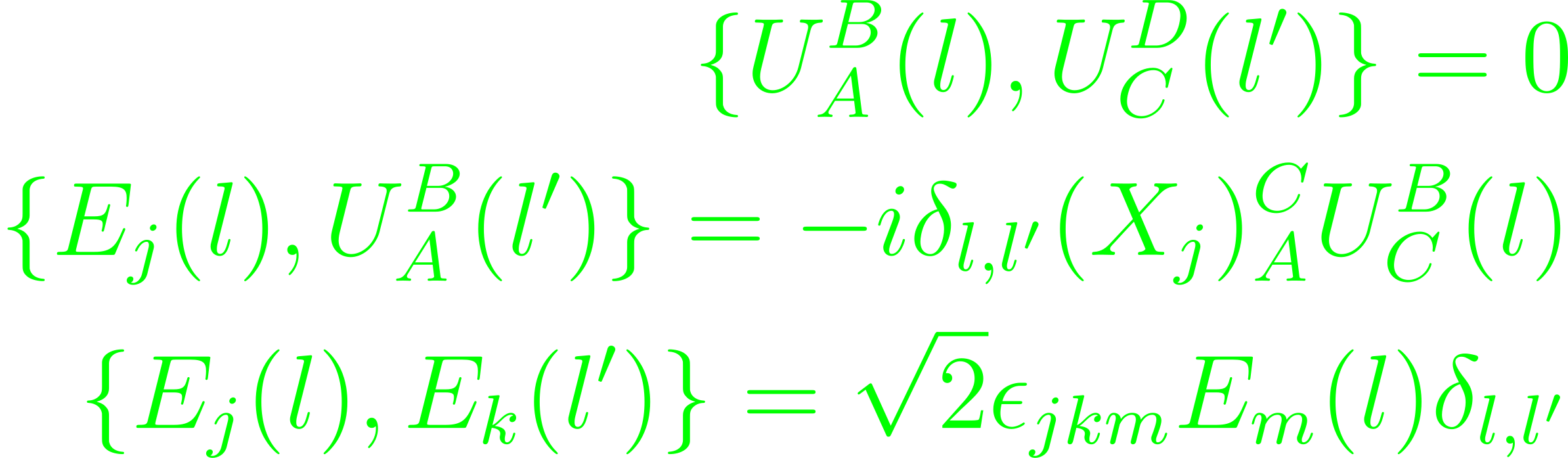
(Eqs. 6.55-57), which, taken to the limits, corresponds to the canonical brackets of the YM theory (Eq. 6.61 - 62). The Gauss law in terms of E is Gj(n) = ∑lnEj(ln) = 0 (Eq. 6.63). A quantum theory in the U-representation requires the usual wavefunctions Ψ(U) which act as would be expected at this point. For every lattice link, the Haar measure associated with SU(2) applies, in which the operators associated with U and E have specific actions
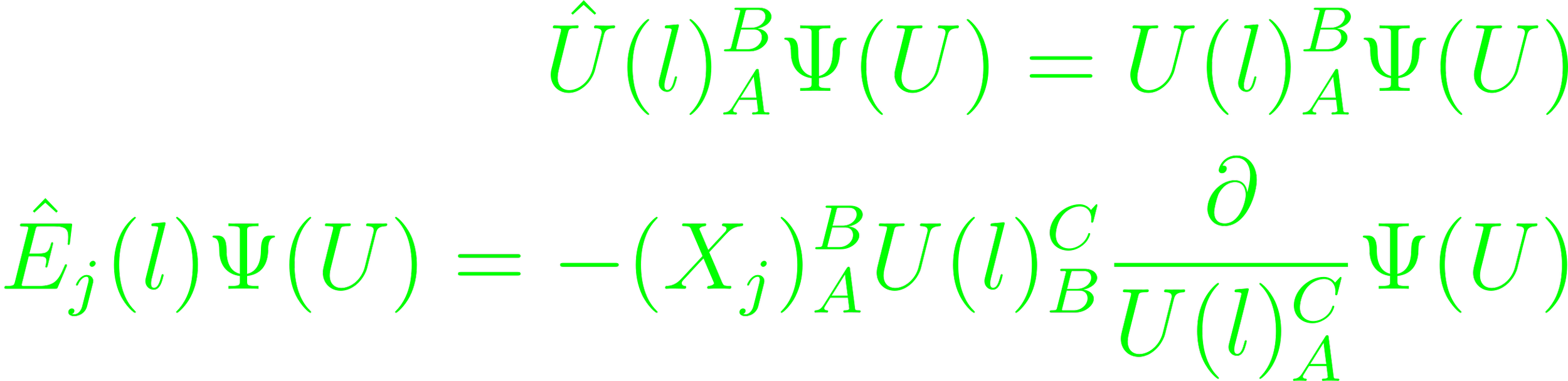
(Eqs. 6.69-70). Given an algebra of classical gauge invariant quantities on the lattice defined by the T-operators with Poisson algebra (Eqs. 6.71 - 75), the quantization realizes the algebra of classical quantities by expressing any product of Wilson loops and their linear combinations through the Mandelstam identities. Multiloops will lead naturally to calculational techniques that are more efficient from the lattice perspective (p. 148). The order of loops in the multiloop is irrelevant (p. 150).
At limit g → ∞ the magnetic term in the YM Hamiltonian drops and the Hamiltonian eigenvalue problem can be solved exactly. Then, the vacuum is a ket with zero loops, and its energy vanishes. The first excited state is given by a plaquette excitation, the second can involve at most two plaquettes, etc, so the magnetic term acts as a perturbation on the electric term. The effect of the magnetic term is to add a plaquette. The perturbative vacuum expression in strong coupling is suppressed by a term 1/g4. The plaquette clusters are considered far away, so the Hamiltonian never connects them. This approximation truncates the basis of all possible states/clusters. Each plaquette is noted as a factor of T0(□) before the vacuum ket. From the electric and magnetic parts of the Hamiltonian emerges a power-law solution for the vacuum (Eq. 6.95), and the excited states are determined by a general Ansatz (Eq. 6.99), which resembles the polynomial construction for Maxwell theory.