Loops, Knots, Gauge Theories and Quantum Gravity 2026, 26 - Yang-Mills Loop Representation
A loop representation for a YM-theory is technically straight-forward. The quantum theory for SU(2) can be derived by quantizing the non-canonical algebra of loop dependent operators using the loop transform. It defines the tensors
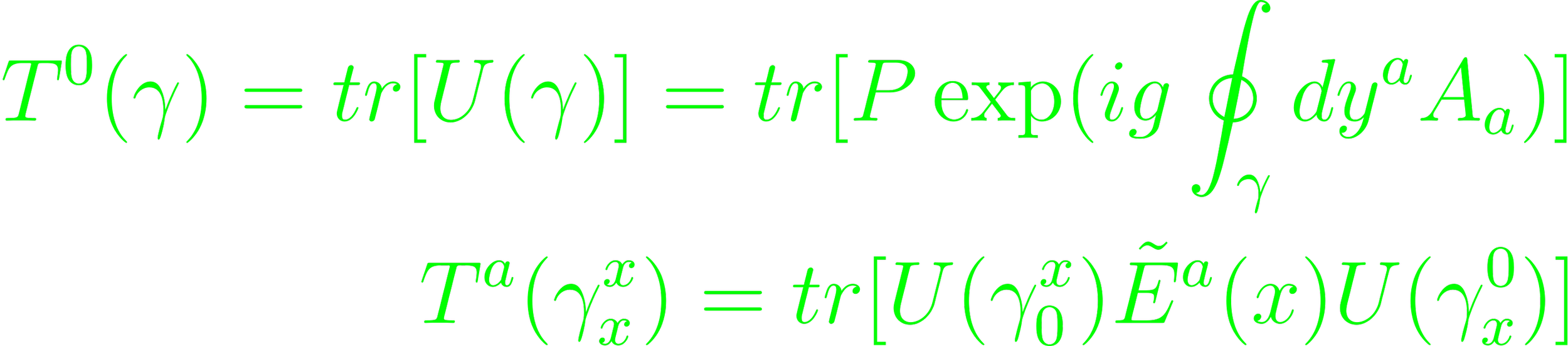
(Eqs. 5.13 - 14), which form a closed algebra, but can't yet express all observables of a YM theory. The Hamiltonian, for example, requires the definition derived for the extended representation (Eq. 5.18). The quantization of the classical non-canonical algebra is performed "on loop basis" (Eq. 5.23 - 5.24) on the space of wavefunctions of loops. From that derives the action of T2 (Eq. 5.25). The smooth loops described by the limits of T2 are eigenstates of the electric part of the YM Hamiltonians (5.3.1). The loop representation for SU(N) YM theories can be built similarly to the SU(2) case. The small algebra is different, needs to be generalized to SU(N), and to tie that up the ordering prescription neutralizes the extra terms that emerges from the extension of the small algebra to SU(N). Then the replacement can happen. The Hamiltonian will again have a magnetic and electric portion (5.3).