A baryon consisting of three spin-1/2 quarks has a wave-function of the form ψ3q = ψ3q, spaceψ3q, spinψ3q, flavour (Eq. 14.1), which has to be symmetric under interchange of any two quarks. By QFT, though, ψ3q should be antisymmetric under this interchange. To resolve this, introduce a new degree of freedom, that is a color wavefunction with colour index α, so that ψ3q, colour = εαβγψαψβψγ (Eq. 14.2) to be appended to the wavefunction. The physical consequences of the addition arises in the multiplicity of quark types in the cross section (14.1). Empirically, SU(3)c is the colour gauge group. By construction it's apparent that the interquark force depends on colour. There is no observation of colour multiplicity in hadronic states, i.e. they are colour singlets. The force has to produce only those very restricted types of quark configuration observed in the hadron spectrum. This restriction is similar to that for spin singlets. Assuming that only colour singlet states exist and the strong interquark force depends only on colour, then the colour dynamics can be derived from the three-quark baryon and the quark-antiquark meson constructions. The singlet constraint could initially emerge from the invariance of the transform of the SU(2) transformation matrix V(1), but it can still permit diquark and antidiquark states, which are not observed. Given special unitary transformation matrix W = exp(iα λ/2) instead, this works as prescribed by observation (14.2.1). Define for it the colour operator F consisting of isospin operators λ1, 2; F = (λ1 + λ2)/2 (Eq. 14.22) (14.2.2). Using SU(3)c implies that gluons are massless vector particles, interacting with themselves via 3-gluon and 4-gluon vertices. The dynamics are summarized into the QCD Lagrangian.
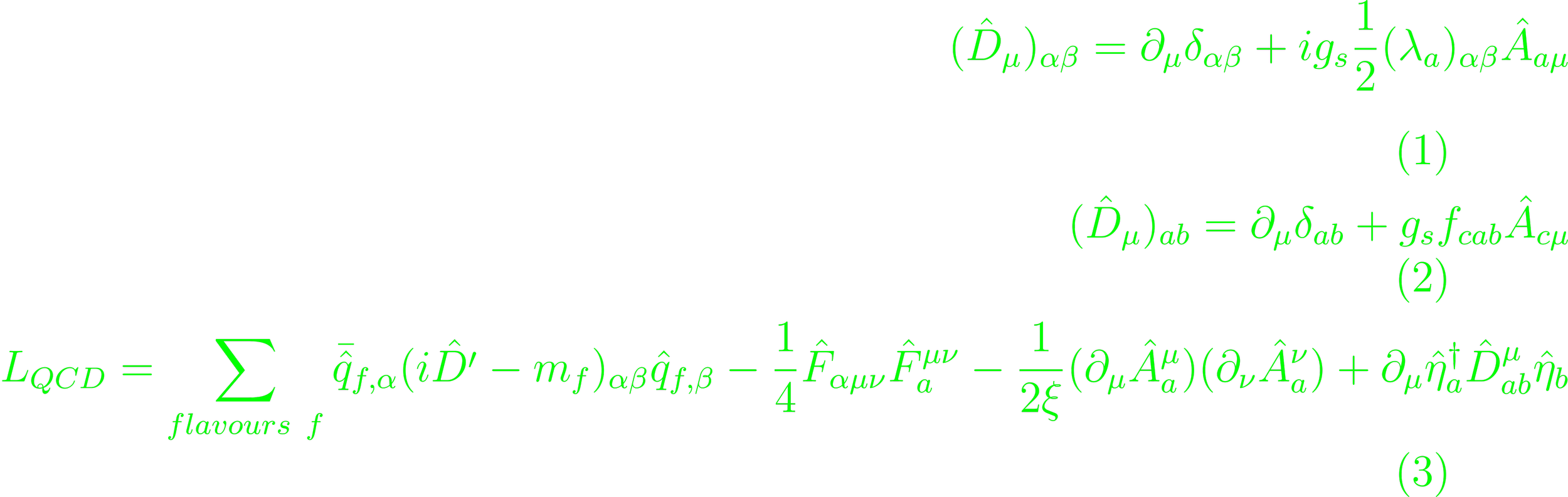
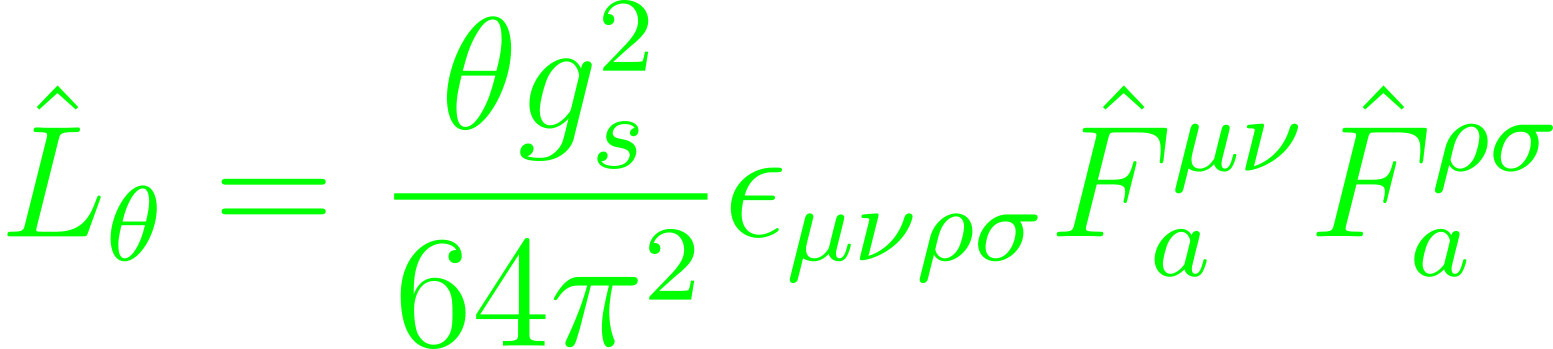
(Eq. 14.33-35). QCD interactions are flavour-blind, so the global flavour symmetries are all preserved by QCD. They include the conservation of each quark flavour. It conserves the discrete PCT symmetries (14.2.3). Beyond gauge principle, the θ-term of QCD from the total divergence's surface term. It describes phenomenological mechanisms
(Eq. 14.40)