Reading a Paper 2026, 07 - Dynamical Equation for Quark Spin Polarization in the Rotating Medium
I a found a paper that concerns itself with gluon-plasma, which, given my passing interest in plasma physics, could be interesting. It looks at non-central relativistic heavy-ion collisions, in which quark-gluon plasma is produced that is modeled as a rotating fluid. In this fluid, the quark spin is polarized as spin couples to angular momentum (and with other particles' spin). The paper aims to derive an expression analogous to the LL equation for heavy quark spin dynamics in this rotating medium, to apply to spin dynamics of heavy quarks in relativistic heavy-ion collisions (Abstract).
A deconfined state of matter composed of quarks and gluons (quark-gluon plasma, QGP) is produced under high-energy nuclear collisions. As a medium, the QCD is a nearly perfect fluid at almost zero viscosity, and large energy loss through heavy quarks. Theoretical studies exist, predicting the yield and momentum distributions of hadrons (by mass). In non-central nuclear collisions, the deconfined medium carries a large initial angular momentum with vorticities up to 20 MeV, which implies a non-zero directed flow of hadrons in the directional rapidity, and a global spin polarization of quarks. Assume that the spin of heavy quarks are modified by spin-angular momentum interaction. Further hadronization can alter the spin-alignment of vector mesons. Landau-Lifshitz and Landau-Lifshitz-Gilbert equations are effective phenomenological models for fermion spin dynamics in a magnetic field, though if the medium rotates, the effects of spin polarization are not as of yet modeled through these terms or derivations (Section 1: Introduction). In a rotating fermionic medium, the Dirac equation changes to

(Eq. 1) where e is the tetrad field. The covariant derivative is defined through an affine connection Cμ. The duality relation defines the specific definition of tetrad field, using the angular momentum ω, and from it, the affine connection emerges.

(Eq. 2). By inserting these definitions back into the Dirac equation, the Hamiltonian emerges. In first approximation, only the heavy quark spin can inspected, which leads to a nonrelativistic form of the heavy-quark Hamiltonian
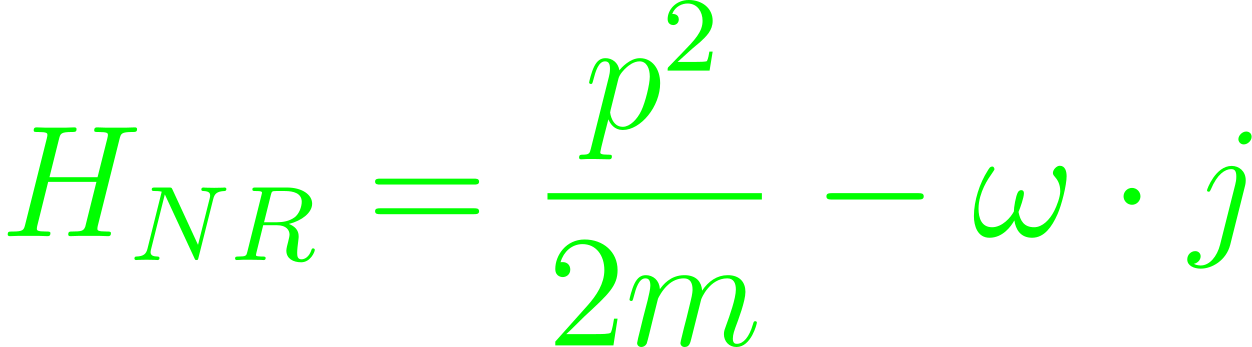
(Eq. 5) (Section 2, Theoretical Model). Energy dissipation here is described by a non-Hermitian Hamiltonian HNR - iλΓ, where Γ is a Hermitian operator and λ a Lagrangian parameter. The precession and polarization around the axis of the medium's angular momentum, is written S/|S| = ⟨ψ|σ|ψ⟩. If complete spin polarization along this axis (choose arbitrarily, but classically z-axis) occurs, then η(t) resolves to unity. The mean value of the heavy quark is
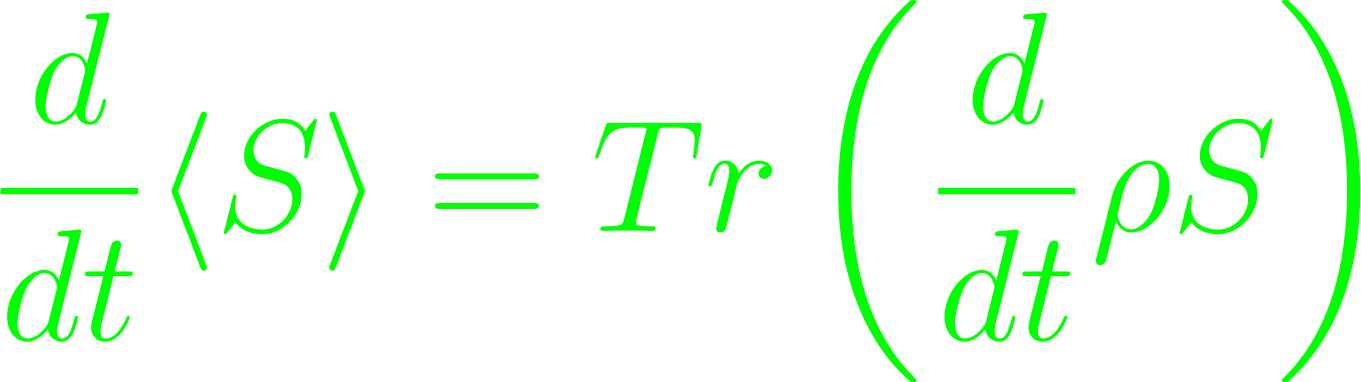
(Eq. 8) with spin density operator ρ, which can be calculated via expansion of the results after evaluating the trace operator through the Liouville equation. Given the quantum-mechanical spin-commutators, it resolves to a simple expression from which the time-evolution of the heavy quark spin vector emerges
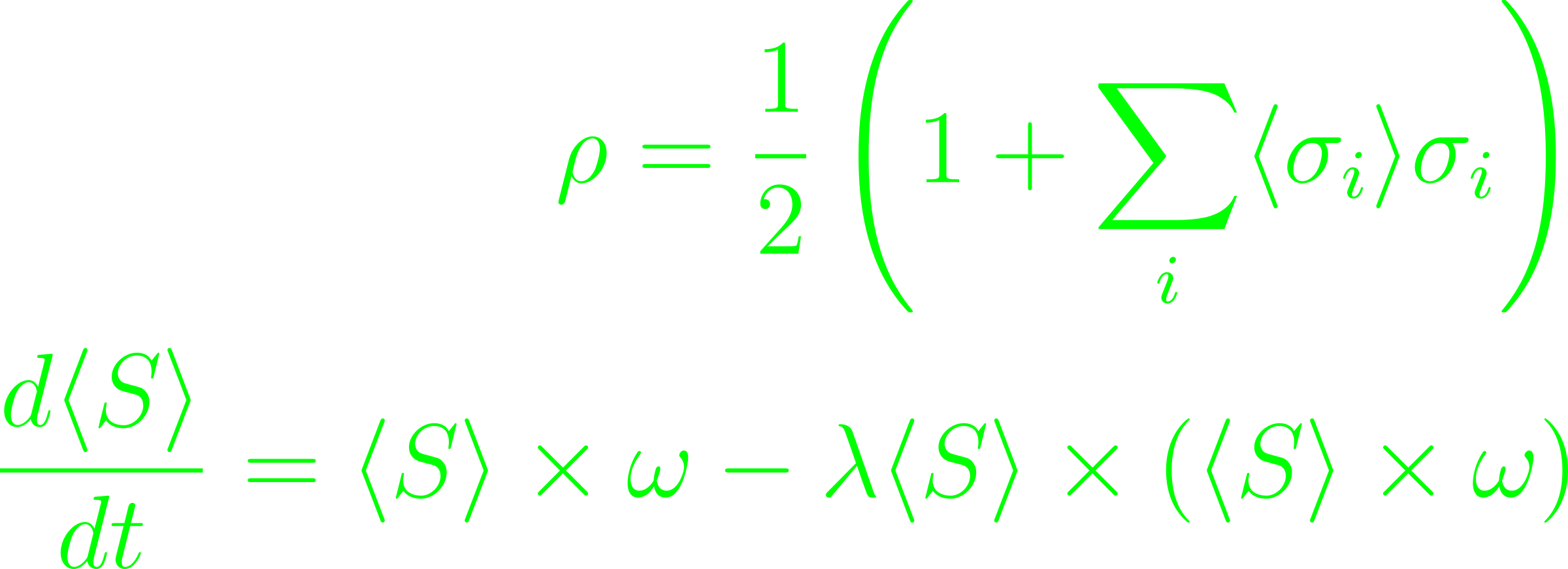
(Eq. 11-12) which closely resembles the LL equation, describing spin dynamics in a fermion system, only to be altered further by the introduction of the noise term ω → ω + ωth. ωth is assumed to be white noise following a Gaussian distribution. The ratio of quark spin depending on whether one uses quantized or continuous distributions is determined to be 1/3 (Section 3, Quantum LL-Like Equation).
The LL-like equation for spin evolution of heavy quarks in the rotating medium in a static medium with constant temperature is employed for a numerical simulation. The medium angular momentum arises from the particle collision energies, and the polarization rate λ. Changing λ will modulate the quark spin vector's behavior over time. The results can be transferred into observations of J/ψ (Section 4, Numerical Results of LL-Like Equation).