Reading a Paper 2026, 09 - Electronic Final States in Nuclear Beta Decay
β-decay changes the Coulomb term of the Hamiltonian. In the minimal one-electron setting, this affects primarily the electron-nucleaus interaction. Higher order terms appear in the general case. For the light channel 3H → 3He+ a nonrelativistic approximation exists, for increasing Z, the role of relativistic structures grow. The electronic wave function is assumed continuous at the decay instant Ψ(0+) = Ψ(0-), and the Hamiltonian jumps from Hi to Hf. Ψ(0+) is not generally an eigenstate of Hf, so it needs to be expanded in the spectrum of the final Hamiltonian
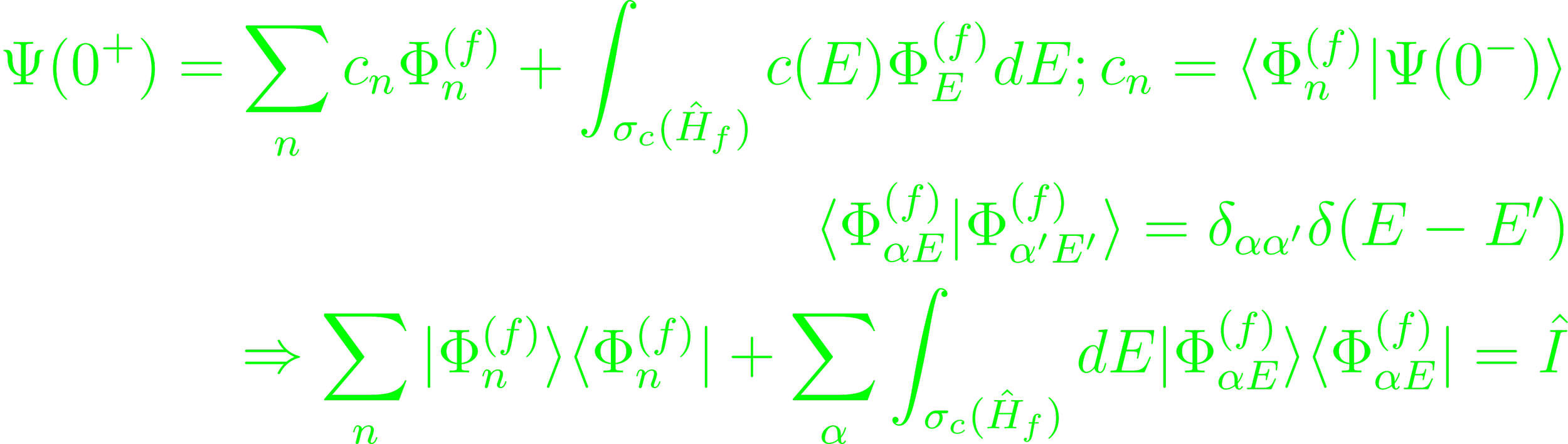
For the one-electron benchmark, only the s-continuum channel is used. The squared moduli of amplitudes determine the observable probabilities of final states (1.0). The paper searches for a transparent theoretical framework for relating the initial electronic state to the full set of final bound and continuum channels after a β-decay transition. The one-electron benchmark results formulate a consistent λ-path connecting the Hamiltonians. λ is used as an interpolation parameter that can set the path between the Hamiltonians and organizes the relation between electronic subspaces, amplitudes and channels. The construction resolves into a λ-homotopy between endpoint Hamiltonians (1.1.). As a minimal system, use the β- decay of tritium. Using, initially,
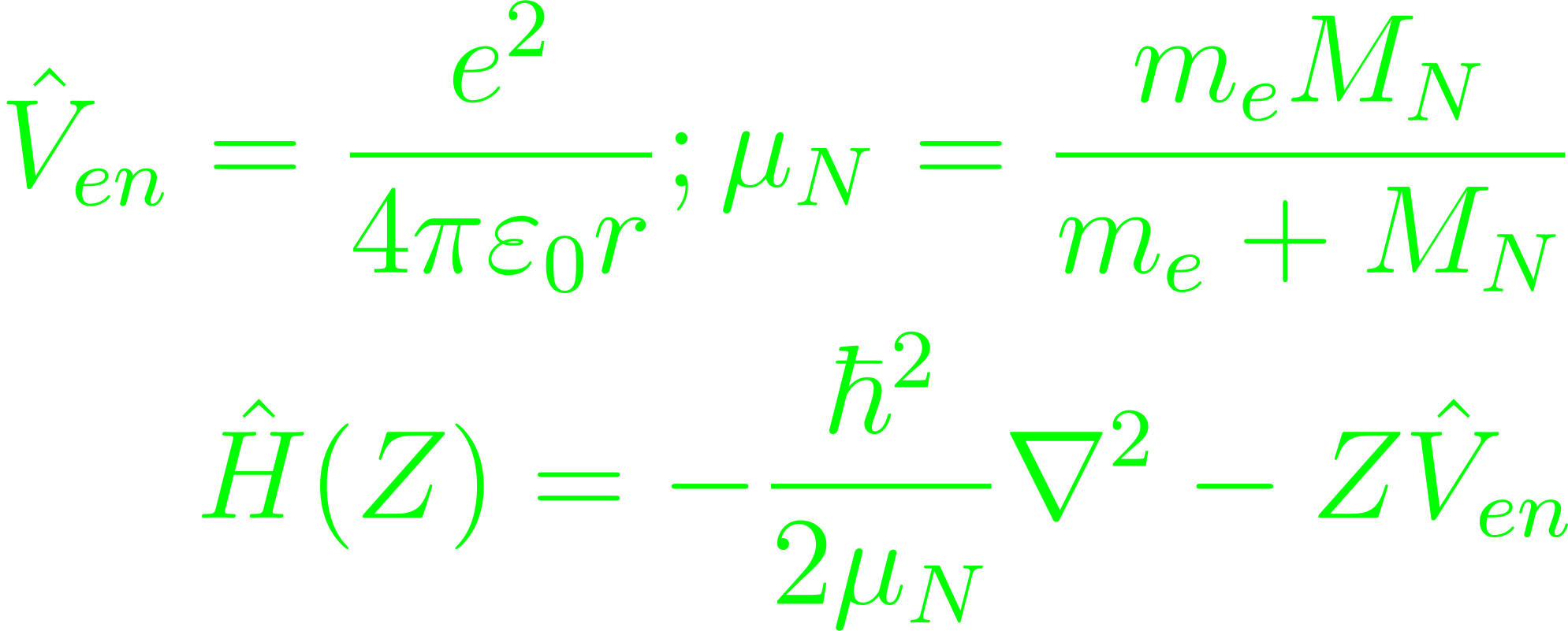
After the transformation, the nuclear mass changes slightly (μi → μf), but this difference is small enough for its effects to be neglected. This implies that the approach would require a separate ansatz for α-decay. The jump in nuclear charge parametrizes the change of Hamiltonians
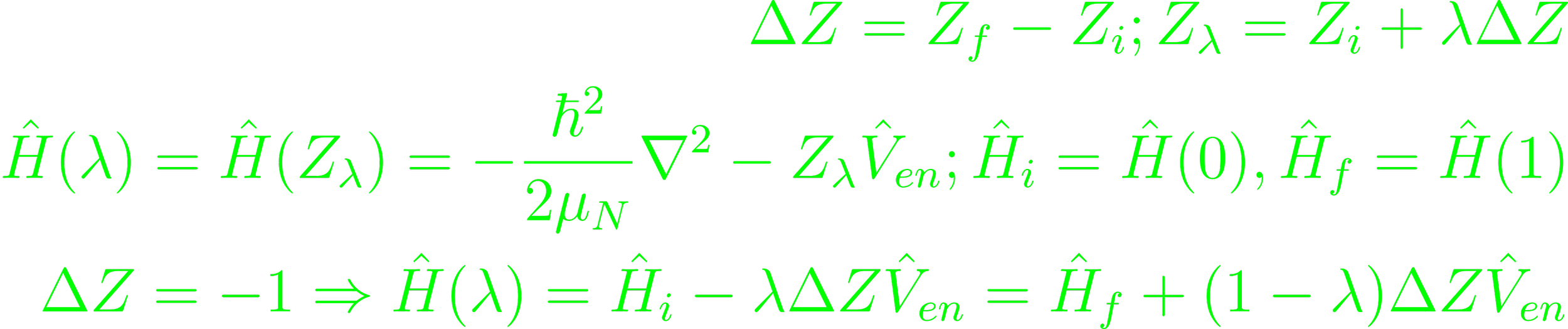
(2.0). In the stationary formulation, the initial electronic wave function is expanded from Hf, and the sum over n describes the contribution of the discrete spectrum. After the eigenvalue problem for the full family is solved, the state can be written in the basis of Hf.
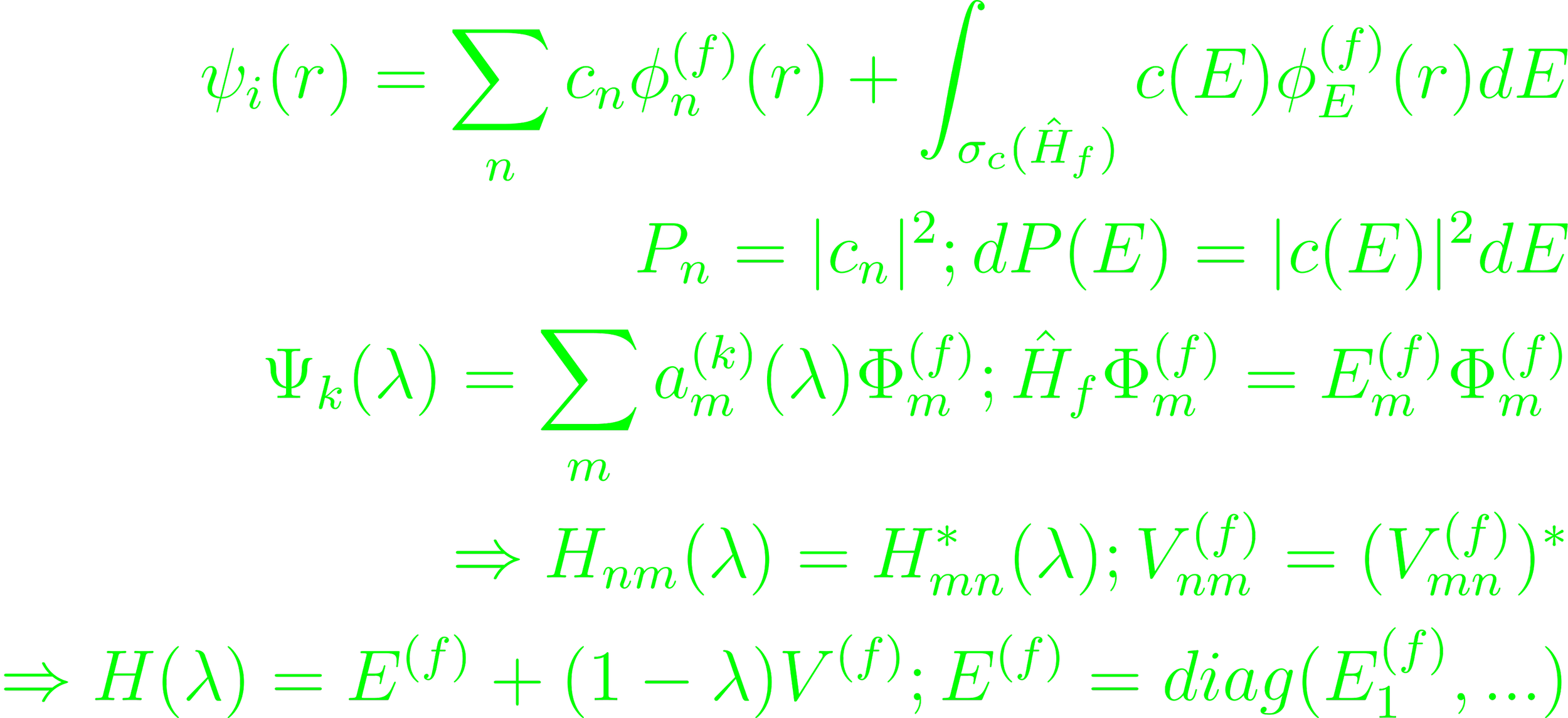
In this formulation, the Rellich-Kato theorem for one-parameter self-adjoint families is naturally retained. Eigenenergies E(λ) are determined by det(H(N)(λ) - EI) = 0, which is generally an N-th degree polynomial in E. Generally, no closed radical formula exists for N ≥ 5 (2.1). In an N-level problem with g-fold degeneracy at λ*, it's best to track the full degenerate subspace with projector Pg(λ*) rather than individual levels, then diagonalizing its perturbation. The resulting eigenvalues define the first-order level splitting in λ (2.2).
The one-electron problem is exactly solvable for any valid λ.
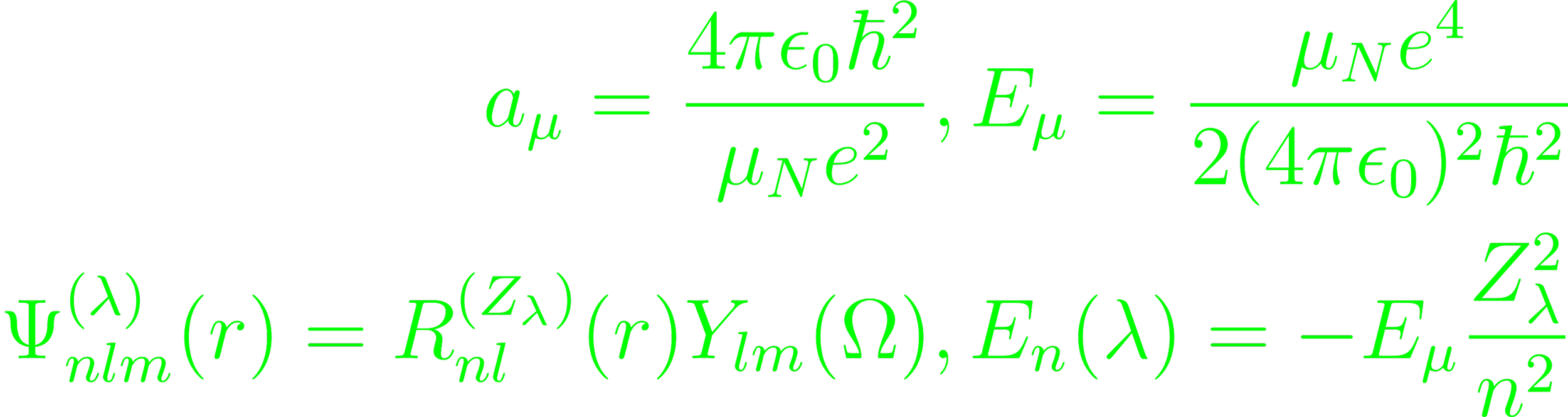
For tritium decay, the branch continuously connects the hydrogen and helium-like endpoints En(0) = En(H), En(1) = En(He+). Generally,

The radial functions take standard hydrogen-like forms. Before continuing, assume that
- At the decay instant, the electronic wave function doesn't have time to change, so all amplitudes are overlaps of the old wave function with the new spectrum
- the potential depends only on r, so angular and radial parts are separable
- the Schrodinger equation with reduced mass is sufficient
- the jump in mass through β decay is negligibly small
- recoil corrections, relativistic, QED effects and explicit coupling to the emitted β electron and antineutrino are neglected, the practical control parameter is Zα
(3.1). It follows, in the one-electron benchmark:
- exact spectral interpolation identity, which shows branch continuity and exact endpoint recovery
- the projection 3H(1s) → 3He+, analytic formulas are derived for c1, c2 and cn ≥ 3
- c(E) and dP/dE = |c(E)|2 are determined analytically for the continuum s channel
- the bound and continuum sectors are of expected sizes
The identity is explicitly

(3.2). Expansion coefficients in eigenstates of the final Hamiltonian are cnlm = ⟨Ψnlm(Zf) | Ψ100(Zi)⟩. The reduction to the radial component is obtained through the wave functions are represented in separated form. The overlap coefficient cnlm can be decomposed partially to the volume element and orthonormality of spherical harmonics. The initial state is 1s, and so the problem reduces to the radial portion. In it, the angular part is evaluated analytically to yield the selection rule for l = 0, m = 0 (3.3). For the continuum s wave using the energy-normalized Coulomb function has parameters of the continuum-state energy E, the momentum in atomic units k = (2E)1/2, the Sommerfeld parameter η = -Zf/k and Coulomb normalization factor C0(η). The probabilities |c(E)|2 agree with those emerging from the channels adding up to spectral completeness (3.4). The λ-dependence is available in closed form for the 1-electron problem. Then, each branch is smooth on the full interval of λ continuously. There are intermediate overlaps cn(λ) = ⟨ns; Zλ | 1s; Zi⟩. The final amplitudes can be obtained without intermediate parameter. The family is essential for extension to the many electron setting. In the many electron problem, the parametric λ acts as a regularization mechanism for nonorthogonality problem in matching initial and final states (3.6).
Transitioning from one-electron to many utilizes effectively the same projection logic. For a single electron, the amplitudes are scalar overlaps between initial and final states. For N electrons, states are represented by Slater determinants and the corresponding overlap objects are determinants and contractions from orbital overlap matrices. The Hamiltonians for the initial and final states
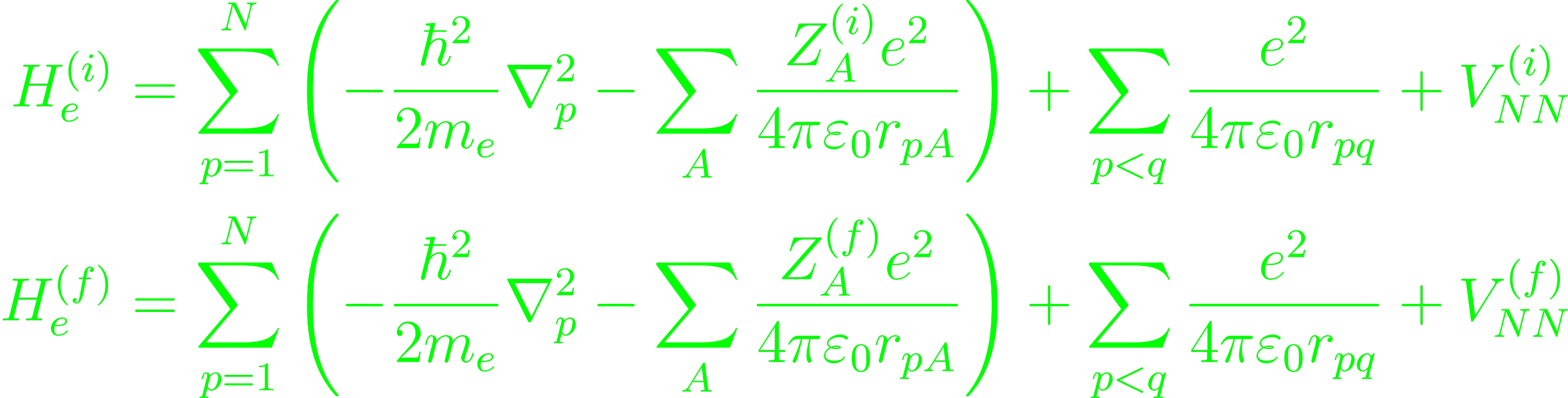
with transmutations at ΔZ = ZB(f) - ZB(i). In the one-electron single-center case, it reduces to the one-electron transmutation boundary. At fixed geometry, the NN term is known, utilizng a constant coefficient of the linear λ-dependence VNB(const) for a single nucleus charge shift at fixed geometry. It affects total electronic energies, but not eigenvectors (4.0). The eigenvalues are associated with a single-determinant reference from orthonormal spin-orbitals. The Hartree-Fock reference is a smooth branch-family in λ (4.1). The non-orthogonal many-electronbases project onto determinants of Smn(LK), which can be contructed to coefficients (4.2). State-specific multireference expansion is written
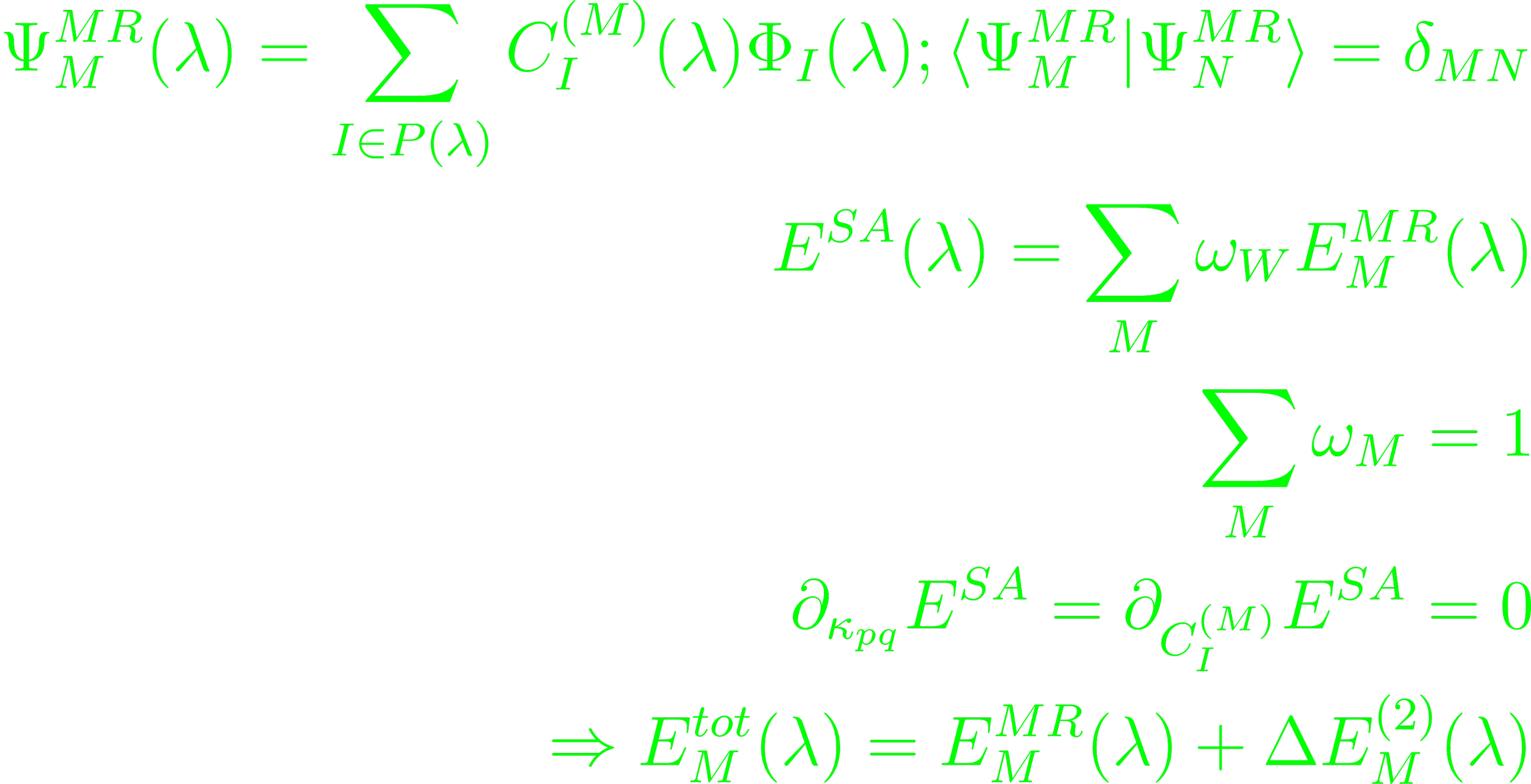
(4.3). A nonorthogonal many-electron working manifold defines spectral branches from a generalized Hermitian problem. Nearl-linear dependencies can be regularized via SVD eigendecomposition, and singular modes below a threshold τ. Overlaps introduce biorthogonal contracted states (4.4).
A grid λk on [0, 1] defines an overlap matrix for neighboring point Ωmnk→k+1 = ⟨Ψm(λk)|Ψn(λk+1)⟩ and branch correspondence is chosen by the permutation P* = arg maxP ∈ Sd ∑nd|Ωn, P(n)k → k + 1 |2 maximizing overlap continuity. By gauge convention, The real part of Ω is strictly positive. Applying Schroedinger's equation to the wave function and the Hellmann-Feynman identity provides terms for the Hamiltonian that can be used for linear interpolation (4.5). The bound channel probablity between initial multireference states and final bound states is determined by standard formalism. From it emerges the expected exact completeness relation (4.6)